Meet an alternative to FilaMan

How does SimplyPrint compare with FilaMan? What's the best 3D printing cloud platform? Discover why SimplyPrint might be what you and your printer never knew you were missing!

Get started - free forever Jump to the comparison table

Looking for FilaMan alternatives?

FilaMan is a genuinely impressive open-source project: a fully MIT-licensed, self-hosted filament manager with a DIY ESP32 load-cell scale, PN532 NFC, a big open filament database and hooks into Bambu, Klipper and OctoPrint. If you love running your own Docker server and don't mind a soldering iron, it's a great hobby setup, and we'll happily concede where it shines.

The difference is what it takes to make tracking happen. FilaMan can deduct filament automatically, but only if you build an ESP32 scale, or stand up an external Bambuddy server, or wire a Klipper/Moonraker plugin, each one self-hosted and printer-specific. SimplyPrint's filament manager reads the G-code of every print on any connected printer, including cloud Bambu and Prusa, and deducts usage on its own, with no scale, no broker, no plugin and no server for you to run. Here's a fair, side-by-side look, first purely as a filament manager, then as the whole platform.

SimplyPrint filament manager

There's a lot more to the SimplyPrint filament manager

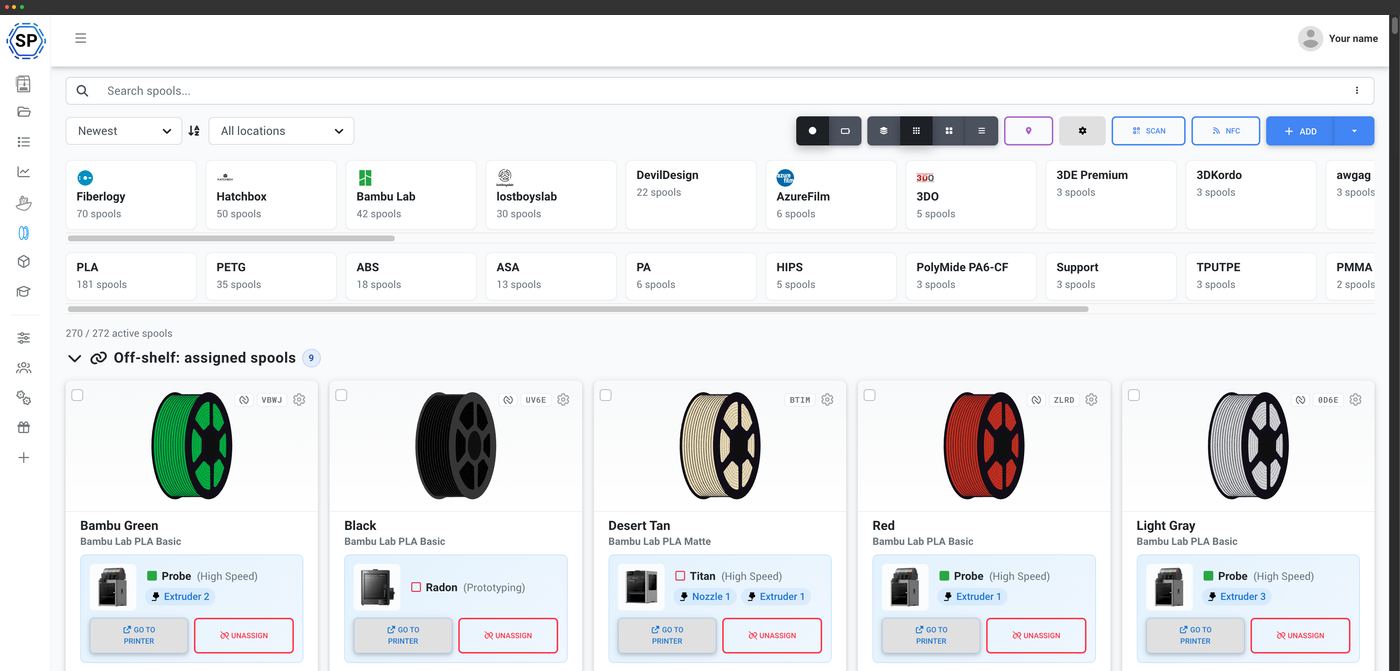
Automatic usage tracking, NFC across every standard, Bambu & Creality AMS auto-import, direct Dymo & Zebra label printing, drying, storage locations, a mobile app and the Open Filament Database. See it all, with screenshots, on one page.

Explore the filament manager
The SimplyPrint filament manager

Compare FilaMan vs SimplyPrint for:

The bottom line

FilaMan is a fully open-source (MIT), self-hosted filament manager built around a DIY ESP32 scale and PN532 NFC, with a large open community database and printer hooks for Bambu, Klipper and OctoPrint. It's a great fit if you want to own your whole stack, run your own Docker server and enjoy building hardware, and it's free to self-host (its mobile apps put core features behind a paid in-app purchase).

SimplyPrint is a connected filament manager that's been running inside a print platform since 2020: it reads the G-code of every print on any connected printer, including cloud Bambu and Prusa, and deducts filament automatically, with no scale, no broker, no plugin and no server to run. Add native cross-brand NFC and AMS auto-import from your phone or browser, direct Dymo and Zebra label printing, free iOS and Android apps, the open MIT Open Filament Database (143 brands), and a full platform around it, all free on every plan. If you want tracking that just happens with nothing to build, that's SimplyPrint; if self-hosting an open-source tool and building your own scale is the point, that's FilaMan.
Comparing purely as a filament manager, the deep, head-to-head view.

Automatic tracking with nothing to build

FilaMan can track usage automatically, and that's real, credit where it's due. The catch is everything you have to assemble first. SimplyPrint is already connected to your printer, so the tracking just happens.

How usage gets deducted
SimplyPrint
We read the G-code of every print on a connected printer, convert it to grams and deduct it from the assigned spool when the print ends, automatically. Any brand, including cloud Bambu Lab and Prusa. No scale, no broker, no plugin, no server.
FilaMan
FilaMan never reads G-code itself. Automatic deduction means you either build a DIY ESP32 load-cell scale to re-weigh, or run an external Bambuddy server for Bambu, or wire a Klipper/Moonraker or OctoPrint plugin, each one self-hosted and printer-specific.
What you set up first
SimplyPrint
Connect the printer and assign a spool. Tracking starts. There's nothing to host, solder, flash or broker, and it's the same flow whether the printer is a cloud Bambu, a Prusa, a Klipper machine or anything else.
FilaMan
Self-host the server in Docker first, then per printer add the right bridge: flash an ESP32 scale, or stand up Bambuddy, or configure a Moonraker/OctoPrint plugin. Every printer brand is its own integration to maintain.
NFC, AMS & labels, no extra box
SimplyPrint
Native NFC read and write across Bambu Lab, Creality CFS, Prusa OpenPrintTag, OpenSpool and OpenTag, from your phone, your browser or a USB reader, plus Bambu and Creality AMS auto-import and direct label printing to Dymo and Zebra thermal printers. No external broker, no hardware to build.
FilaMan
NFC is real but DIY: a PN532 you wire yourself, reading OpenSpool and FilaMan tag formats only (no Bambu, Creality or Prusa proprietary tags). AMS is Bambu slot-mapping over MQTT, with per-slot weight deduction only through the external Bambuddy server. Labels are a QR designer, with no documented direct Dymo or Zebra printing.
FilaMan absolutely tracks filament automatically. The difference is that with SimplyPrint there is nothing to build, host or wire up per printer, and it works on any brand, including the cloud ones, out of the box.

Hosted for you, with free apps in your pocket

FilaMan is something you run. SimplyPrint is something you sign in to. That shows up in who keeps the server alive and what it costs to use on your phone.

Who runs the server
SimplyPrint
Hosted for you (on-prem is an enterprise option), so there's no Docker host, database, TLS, backups or updates to manage. You sign in and start, and it's been running as a platform since 2020.
FilaMan
Self-host only: you provide and maintain the Docker server, the database and remote access. FilaMan is also a very new (2025/2026 rewrite), rapidly iterating, effectively single-developer hobby project, which is a strength for tinkerers and a consideration for a business.
Mobile apps
SimplyPrint
Free native iOS and Android apps, hosted, so they work from anywhere the moment you sign in, no instance to point them at.
FilaMan
FilaMan ships native iOS and Android apps too, but they connect only to your own self-hosted instance, and core features in the apps sit behind a paid in-app purchase.
If you want a filament manager you run end to end and don't mind self-hosting, FilaMan is genuinely capable. If you'd rather just sign in, with free apps and nothing to keep alive, that's SimplyPrint.

Where FilaMan is the better pick

FilaMan is a well-made open-source project, and for some setups it's the right call. Credit where it's due:

Fully open-source & self-hosted
SimplyPrint
Hosted for you (on-prem is an enterprise option), and we open-source our data and peripheral tooling, the Open Filament Database, our slicer profiles and the OctoPrint plugin, but the core platform is our cloud.
FilaMan
The entire application is MIT-licensed, server and ESP32 firmware and database software alike, and self-hostable with one Docker command. If owning and auditing the whole stack, or an air-gapped, no-cloud setup, is a hard requirement, FilaMan is genuinely the more open choice.
A real DIY load-cell scale
SimplyPrint
We deduct from G-code, which needs no hardware, but it is an estimate from the slice, not a physical weight.
FilaMan
FilaMan's open-source ESP32 + HX711 load-cell scale, with published schematics, PCB and printable files, gives a true measured weight, an accuracy a software estimate can't match, and a satisfying build if you like hardware.
If you want a fully open-source tool you self-host, the privacy of a no-cloud setup, and a real load-cell scale you build yourself, FilaMan is a fine choice, and the server is free. If you'd rather the tracking just happen, on any printer, with free apps and no server to run, that's SimplyPrint.
The bottom line

FilaMan does one job, filament management, and self-hosts it openly. SimplyPrint includes that same filament manager and surrounds it with the rest of a print operation: a print queue, a full cloud slicer, AI failure and bed detection, a maintenance system, teams and permissions, mobile apps and more, in one hosted platform that's free to start. In the table below, FilaMan's column is filament; ours is the whole platform.

The same filament comparison, plus everything else SimplyPrint does that a filament tool doesn't.

Automatic tracking with nothing to build

FilaMan can track usage automatically, and that's real, credit where it's due. The catch is everything you have to assemble first. SimplyPrint is already connected to your printer, so the tracking just happens.

How usage gets deducted
SimplyPrint
We read the G-code of every print on a connected printer, convert it to grams and deduct it from the assigned spool when the print ends, automatically. Any brand, including cloud Bambu Lab and Prusa. No scale, no broker, no plugin, no server.
FilaMan
FilaMan never reads G-code itself. Automatic deduction means you either build a DIY ESP32 load-cell scale to re-weigh, or run an external Bambuddy server for Bambu, or wire a Klipper/Moonraker or OctoPrint plugin, each one self-hosted and printer-specific.
What you set up first
SimplyPrint
Connect the printer and assign a spool. Tracking starts. There's nothing to host, solder, flash or broker, and it's the same flow whether the printer is a cloud Bambu, a Prusa, a Klipper machine or anything else.
FilaMan
Self-host the server in Docker first, then per printer add the right bridge: flash an ESP32 scale, or stand up Bambuddy, or configure a Moonraker/OctoPrint plugin. Every printer brand is its own integration to maintain.
NFC, AMS & labels, no extra box
SimplyPrint
Native NFC read and write across Bambu Lab, Creality CFS, Prusa OpenPrintTag, OpenSpool and OpenTag, from your phone, your browser or a USB reader, plus Bambu and Creality AMS auto-import and direct label printing to Dymo and Zebra thermal printers. No external broker, no hardware to build.
FilaMan
NFC is real but DIY: a PN532 you wire yourself, reading OpenSpool and FilaMan tag formats only (no Bambu, Creality or Prusa proprietary tags). AMS is Bambu slot-mapping over MQTT, with per-slot weight deduction only through the external Bambuddy server. Labels are a QR designer, with no documented direct Dymo or Zebra printing.
FilaMan absolutely tracks filament automatically. The difference is that with SimplyPrint there is nothing to build, host or wire up per printer, and it works on any brand, including the cloud ones, out of the box.

Hosted for you, with free apps in your pocket

FilaMan is something you run. SimplyPrint is something you sign in to. That shows up in who keeps the server alive and what it costs to use on your phone.

Who runs the server
SimplyPrint
Hosted for you (on-prem is an enterprise option), so there's no Docker host, database, TLS, backups or updates to manage. You sign in and start, and it's been running as a platform since 2020.
FilaMan
Self-host only: you provide and maintain the Docker server, the database and remote access. FilaMan is also a very new (2025/2026 rewrite), rapidly iterating, effectively single-developer hobby project, which is a strength for tinkerers and a consideration for a business.
Mobile apps
SimplyPrint
Free native iOS and Android apps, hosted, so they work from anywhere the moment you sign in, no instance to point them at.
FilaMan
FilaMan ships native iOS and Android apps too, but they connect only to your own self-hosted instance, and core features in the apps sit behind a paid in-app purchase.
If you want a filament manager you run end to end and don't mind self-hosting, FilaMan is genuinely capable. If you'd rather just sign in, with free apps and nothing to keep alive, that's SimplyPrint.

Where FilaMan is the better pick

FilaMan is a well-made open-source project, and for some setups it's the right call. Credit where it's due:

Fully open-source & self-hosted
SimplyPrint
Hosted for you (on-prem is an enterprise option), and we open-source our data and peripheral tooling, the Open Filament Database, our slicer profiles and the OctoPrint plugin, but the core platform is our cloud.
FilaMan
The entire application is MIT-licensed, server and ESP32 firmware and database software alike, and self-hostable with one Docker command. If owning and auditing the whole stack, or an air-gapped, no-cloud setup, is a hard requirement, FilaMan is genuinely the more open choice.
A real DIY load-cell scale
SimplyPrint
We deduct from G-code, which needs no hardware, but it is an estimate from the slice, not a physical weight.
FilaMan
FilaMan's open-source ESP32 + HX711 load-cell scale, with published schematics, PCB and printable files, gives a true measured weight, an accuracy a software estimate can't match, and a satisfying build if you like hardware.
If you want a fully open-source tool you self-host, the privacy of a no-cloud setup, and a real load-cell scale you build yourself, FilaMan is a fine choice, and the server is free. If you'd rather the tracking just happen, on any printer, with free apps and no server to run, that's SimplyPrint.
Join 90.000+ print farms & hobbyists
who use SimplyPrint
Get started

Free forever. No credit card.

Our users love us. Rated Excellent on Trustpilot.

4.7 Trustpilot score

FilaMan and SimplyPrint comparison

Nothing is black-and-white, and there are always pros and cons to consider when choosing a 3D printing cloud solution!
And we're not here to simply tell you, that SimplyPrint is the best - we want you to make an informed decision, and of course there are pros of using FilaMan as well!

Pros of using FilaMan

FilaMan has real strengths, and they're worth being honest about:

  • Fully open-source (MIT): the entire application, server, ESP32 firmware and database software, is MIT-licensed and self-hostable with one Docker command, so you can fork, audit and own the whole stack.
  • An open-source DIY smart scale: an ESP32 + HX711 load cell + PN532 NFC build with published schematics, PCB and printable files, giving a real measured weight, hardware SimplyPrint doesn't ship.
  • A large open community database: FilamentDB lists tens of thousands of filaments across hundreds of brands, MIT-licensed software with manufacturer self-registration, a REST API and CSV/Excel import.
  • Real automatic deduction (with a path chosen): per-print consumption for Bambu via Bambuddy and for Klipper/Moonraker via extrusion-length-to-grams, plus deep Spoolman compatibility (a drop-in Spoolman replacement), Home Assistant, OpenSpool NFC and Bambu AMS slot mapping over MQTT.
  • Privacy-first and self-hosted: no tracking, no ads, no cloud; your data stays on your own instance, a real plus for privacy or air-gapped setups.
  • Active, fast-moving development: a mature, multi-release project (1,284+ commits across its history) with frequent point releases and basic role-based multi-user access (Administrator / User / Viewer).

Cons of using FilaMan

Where FilaMan asks more of you if you want tracking that just happens:

  • Automatic tracking means building something first: FilaMan never reads G-code itself, so auto-deduction needs either a DIY ESP32 load-cell scale, an external Bambuddy server, or a Klipper/Moonraker or OctoPrint plugin, each self-hosted and specific to that printer.
  • You run the server: there's no hosted option, so the Docker host, database, TLS, remote access, backups and updates are all on you, which is exactly what some people want, and a chore for others.
  • The mobile apps gate core features: FilaMan's native iOS and Android apps connect only to your own instance, and core features in the apps sit behind a paid in-app purchase.
  • NFC and AMS are DIY and narrower: NFC is a PN532 you wire yourself, reading OpenSpool and FilaMan formats only (no Bambu, Creality or Prusa proprietary tags), and AMS is Bambu slot-mapping, with per-slot weight only through the external Bambuddy server.
  • Flat locations and no direct thermal labels: storage locations are a flat list with no nesting, and there's a QR label designer but no documented direct printing to Dymo or Zebra.

FilaMan vs. SimplyPrint

Side-by-side list comparison of details and features in FilaMan and SimplyPrint

FilaMan logo SimplyPrint logo
Filament management
Free to use Server free (MIT, self-host); app features paid
Open-source / self-hostable ?
Filament database ? FilamentDB (large, open) Open Filament Database
Open, community-built database ?
Add filament without code or GitHub ?
Connects directly to your printer ?
Automatic usage tracking (no manual subtracting) ? Via DIY scale, Bambuddy or a plugin
AMS auto-import (Bambu / Creality / Anycubic) ? Bambu slot-mapping; weight via Bambuddy Bambu, Creality, Anycubic + more
Read filament NFC tags
Write filament NFC tags
Label printing (direct to Dymo / Zebra) QR designer; no thermal driver Dymo & Zebra
Barcode / QR scanning
Drying tracking
Storage locations Flat list, no nesting
Cost & spend tracking
Custom fields
Mobile app (iOS & Android) Yes; core features paid
Multi-user / team access
Import your existing spools ? Via Spoolman (compatible)
Developer API for filament data ?
Dedicated hardware (scale / reader / dryer) ?
Compare Learn more Learn more
FilaMan logo SimplyPrint logo
Filament management
Free to use Server free (MIT, self-host); app features paid
Open-source / self-hostable ?
Filament database ? FilamentDB (large, open) Open Filament Database
Open, community-built database ?
Add filament without code or GitHub ?
Connects directly to your printer ?
Automatic usage tracking (no manual subtracting) ? Via DIY scale, Bambuddy or a plugin
AMS auto-import (Bambu / Creality / Anycubic) ? Bambu slot-mapping; weight via Bambuddy Bambu, Creality, Anycubic + more
Read filament NFC tags
Write filament NFC tags
Label printing (direct to Dymo / Zebra) QR designer; no thermal driver Dymo & Zebra
Barcode / QR scanning
Drying tracking
Storage locations Flat list, no nesting
Cost & spend tracking
Custom fields
Mobile app (iOS & Android) Yes; core features paid
Multi-user / team access
Import your existing spools ? Via Spoolman (compatible)
Developer API for filament data ?
Dedicated hardware (scale / reader / dryer) ?
General
Has free plan
Free printers 2
Max cost Free, self-hosted Free, or from $4/printer/mo
Free cloud storage 1GB
Usage based cost
Unlimited printing
Supports all printers
Features
Remote access
Knows your printer
Cloud files
Print queue
Livestream
Gcode analysis
A.I failure detection
AI Bed Check (is the bed clear?)
AutoPrint / continuous printing
Maintenance & servicing system
Custom fields
Staggered Start (for power draw)
Print job history
Print remotely
Built-in slicer
Multi-printer friendly
Multi-print
Multi-stream
Statistics
API
Slicer smart-rotation
Smart filament change
Bed level helper
Organization
Multiple users
User groups / ranks
User permissions
School plan
Shared files & folders
Shared slicer profiles
Hub
Custom domains
SSO (single sign-on)
Notifications
Email notifications
Push (mobile / app) notifications
SMS / text message notifications
Apps
Android app
iOS app
"PWA" (installable web-application)
Security & privacy
Account 2-factor authentication
Privacy-minded analytics & data-gathering ?
Support
Live-chat support
Phone support
Email support
Firmware & gateway support
OctoPrint install
Native Moonraker support
Mainsail install
Fluidd install
Klipper support
Duet3D integration
Direct Prusa support (MK4, XL and up / new main boards)
Direct Bambu Lab printer integration
Support for custom integrations
Enterprise & partners
OEM
Partner program (reseller / distributor)
Affiliate program
On-prem / self-hosting ? Contact us
Compare Learn more Learn more

Contact us if you think we made a mistake in our comparison!

FilaMan vs. SimplyPrint: frequently asked questions

Is SimplyPrint or FilaMan better for filament tracking?

It depends on what you want. FilaMan is the better fit if you specifically want a fully open-source tool you self-host, you enjoy building a DIY ESP32 scale, and you're happy wiring up a plugin or broker per printer. SimplyPrint is the better fit if you want filament tracking that happens automatically with nothing to build: it connects to your printers, reads the G-code of each print and deducts filament on its own, across any brand including cloud Bambu and Prusa, with native NFC, Bambu and Creality AMS auto-import, direct Dymo/Zebra labels, free mobile apps and the Open Filament Database, free on every plan.

Does FilaMan track filament usage automatically?

Yes, but it never reads G-code itself, so automatic deduction means choosing a path and setting it up: build a DIY ESP32 load-cell scale to re-weigh, run an external Bambuddy server for Bambu, or wire a Klipper/Moonraker or OctoPrint plugin, each self-hosted and specific to that printer. SimplyPrint reads the G-code of every print on a connected printer and deducts usage automatically, on any brand including cloud Bambu and Prusa, with no scale, broker, plugin or server to run.

Is FilaMan free and open-source?

Yes. FilaMan is fully open-source and MIT-licensed across the whole application, server, ESP32 scale firmware and database software, and the server is free to self-host with one Docker command. You do provide and run the server, and core features in its mobile apps sit behind a paid in-app purchase. SimplyPrint's filament manager is also free, included on every plan down to Free, with automatic G-code tracking, free native iOS and Android apps and the Open Filament Database, and there's no server for you to run.

Is FilaMan more open-source than SimplyPrint?

At the software level, yes, and we'll say so plainly: FilaMan open-sources its entire application under MIT, while SimplyPrint open-sources its data and peripheral tooling, the Open Filament Database, our slicer profiles and the OctoPrint plugin, but not the core hosted platform. If owning and auditing the whole stack is a hard requirement, FilaMan is the more open choice. Where SimplyPrint wins isn't openness; it's that the tracking just happens on any connected printer with nothing to host or build.

Does FilaMan have a filament database, and is it as good as the Open Filament Database?

Both are large and open, and FilaMan's FilamentDB actually lists more entries on raw count, with manufacturer self-registration, a REST API and CSV/Excel import. SimplyPrint uses the MIT-licensed Open Filament Database (143 brands), editable in a no-code web editor and wired directly into slicing profiles and automatic deduction. The real difference isn't catalogue size, it's the open MIT license, the no-code web editor, and being connected to the printer so usage is tracked for you.

Does FilaMan work with the Bambu Lab AMS or NFC tags?

Partly. FilaMan maps Bambu AMS slots and pushes settings over MQTT, but per-slot weight deduction needs the external Bambuddy server. Its NFC is a DIY PN532 you wire yourself, reading and writing OpenSpool and FilaMan tag formats only, not Bambu, Creality or Prusa proprietary tags. SimplyPrint reads Bambu and Creality AMS to auto-create and auto-assign spools and sync their weight, and reads and writes NFC across Bambu, Creality CFS, Prusa OpenPrintTag, OpenSpool and OpenTag, from your phone, browser or a USB reader, with no external broker.

Can I move my FilaMan inventory into SimplyPrint?

Indirectly, yes. FilaMan is Spoolman-API compatible, and SimplyPrint lists Spoolman as a supported import source, so you can route your inventory across through that Spoolman compatibility, with brands matched against the Open Filament Database as they import. A direct FilaMan-to-SimplyPrint round-trip isn't a verified one-click flow, so treat it as a Spoolman-bridge import.

Conclusion
Why SimplyPrint is the Top FilaMan Alternative

We made SimplyPrint due to the fact, that nothing else on the market quite fit our needs. We wanted a platform that was easy to use, but still had all the features we needed. We wanted a feature-rich platform, intuitive and easy to use, with a great user experience and actual innovation within the 3D print management software space.

In summary, we - humble and unbiased as we are 😉 - believe that the SimplyPrint platform is a great FilaMan alternative!

Get started - free forever

On this page