Customer-controlled data boundary
Keep the application and agreed data stores inside infrastructure operated by your organisation or its approved provider.
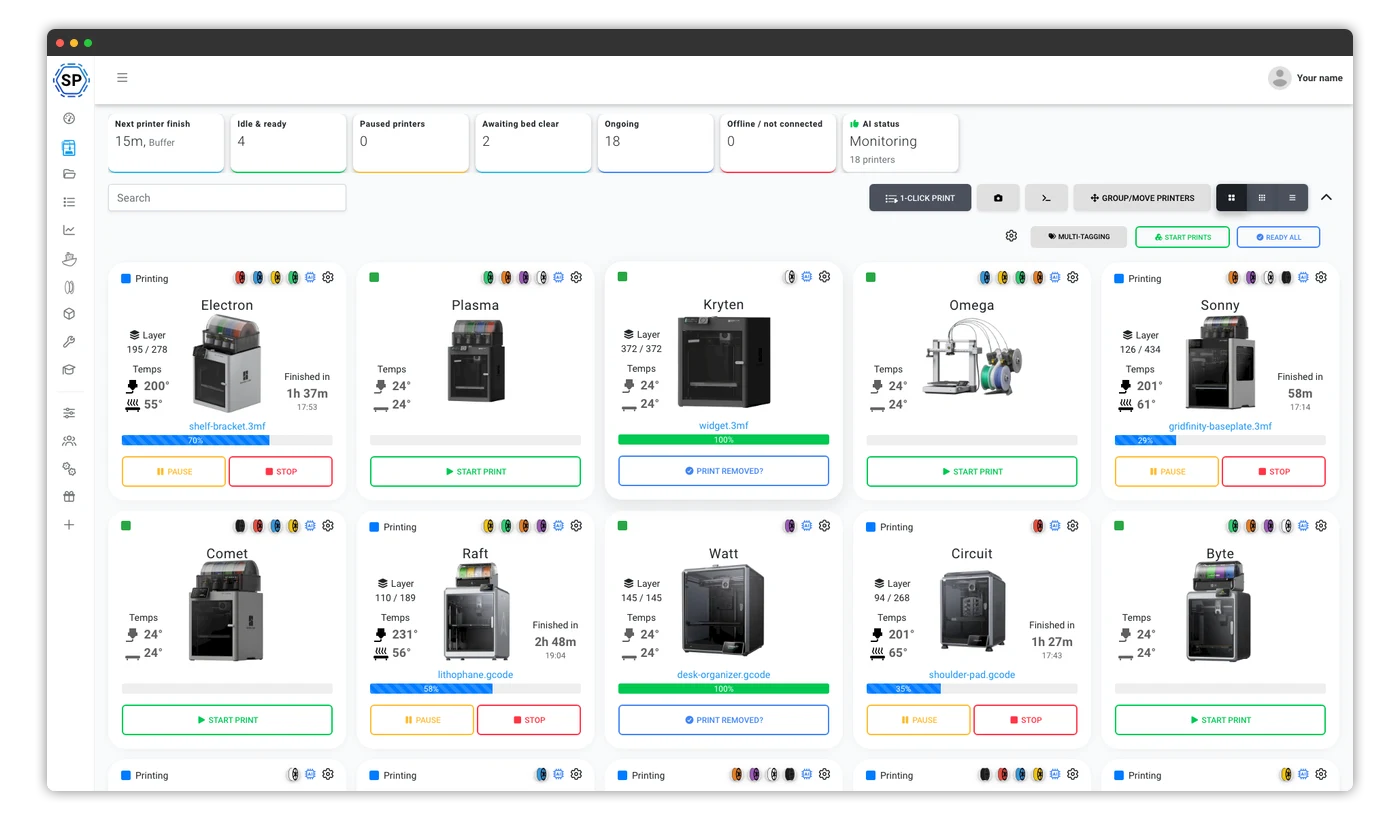
Self-hosted 3D printer management
Choose the managed cloud for the fastest self-serve start, or scope a custom on-premise Enterprise deployment with your IT and security teams.
Organisations across industries using SimplyPrint



















Started prints
0
Material usage
0
Hours printed
0
SimplyPrint on-premise can be scoped for select Enterprise customers that need the 3D printer management platform on customer-controlled infrastructure. Architecture, operations, updates and support are agreed for each environment. SimplyPrint has been used to manage real 3D printing operations since 2020.
Running 3D printing operations since 2020
Built in-house by our own developers in Denmark, who ship updates almost every week and answer support questions too.
Read our story and meet the teamKeep printers, files, members and local settings separate by facility while central administrators manage the group through one Enterprise organisation.
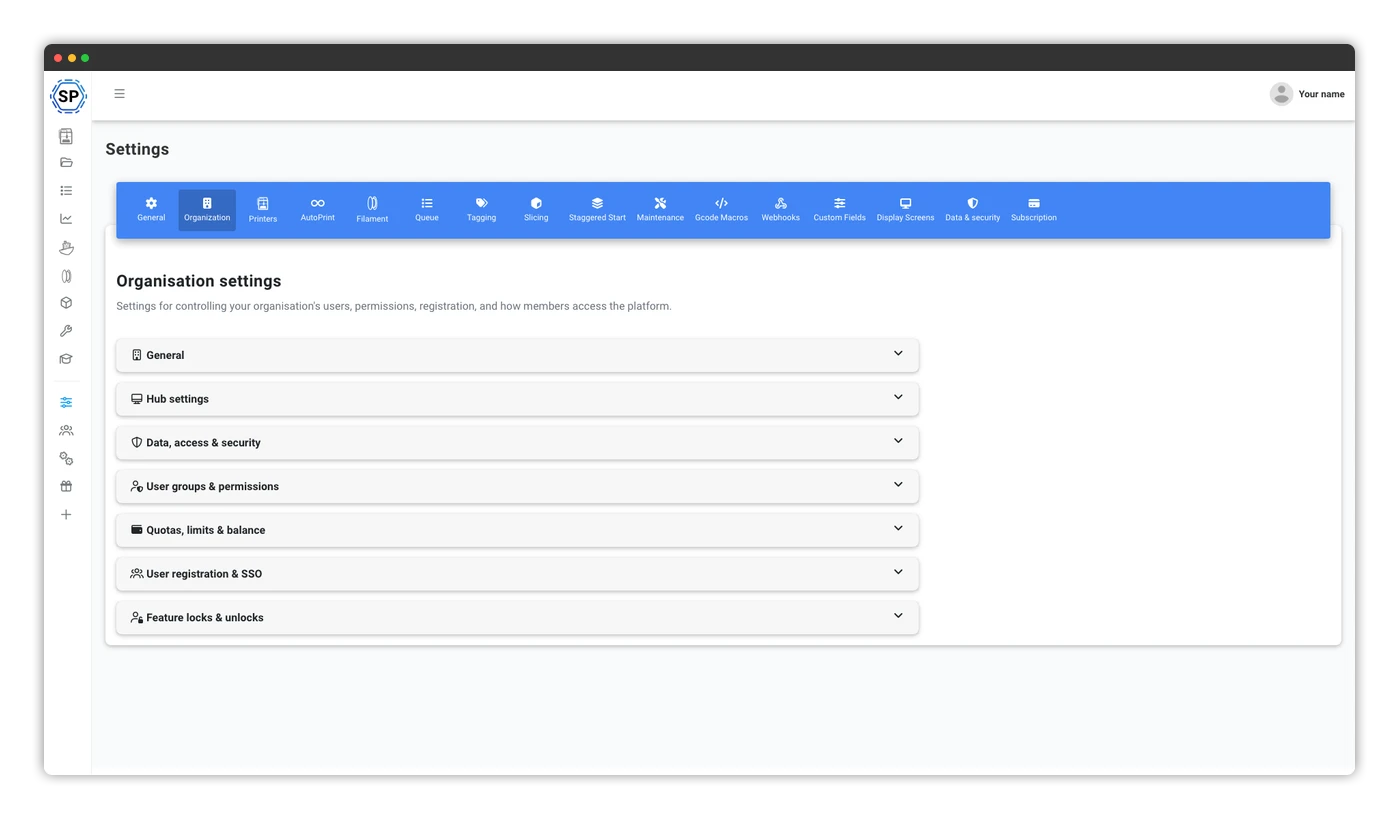
Model plants, labs, offices or campuses as separate locations. Local teams stay focused on their own fleet; central administrators can switch across the group.
Use the main organisation's SAML or OIDC provider across locations, with the option for a location-specific identity provider where policy differs.
Map values from a SAML attribute or OIDC claim to the right location or locations, then place users there when they sign in.
Share printer and user capacity under consolidated billing, or connect a location to its own Enterprise subscription without losing central management and SSO.
Most organisations are better served by the managed cloud. On-premise is for Enterprise teams with a defined infrastructure, data-boundary or network requirement and an operational owner.
Keep the application and agreed data stores inside infrastructure operated by your organisation or its approved provider.
Scope deployment inside a customer-operated private-cloud or government-cloud environment without implying that SimplyPrint itself holds that environment's authorization.
Define ingress, egress, identity, printer connectivity and support access before implementation. Disconnected operation requires a separate technical review.
Agree ownership for capacity, credentials, backups, monitoring, incident response and the update path before the system goes live.
A self-hosted deployment starts with requirements and responsibility, not a public download or a one-size-fits-all Compose file.
Document the fleet, users, data boundary, identity provider, networks, integrations and applicable controls.
Map the containerized service roles, database, cache, object storage, network paths and capacity to your environment.
Test printer connectivity, identity, backups, monitoring, upgrades and any restricted-network assumptions with the real topology.
Run under an agreed maintenance, security-update, support and incident-response model with named owners on both sides.
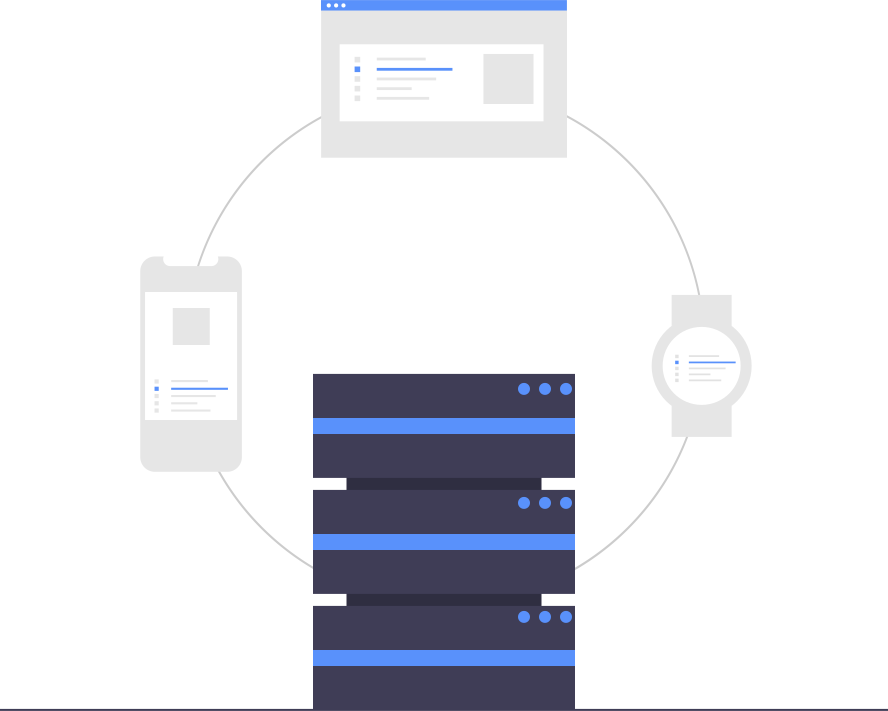
SimplyPrint's application architecture separates web and API traffic, real-time communication, scheduled workers, relational data, Redis and S3-compatible object storage. The exact production topology, orchestration and capacity are designed for the agreed deployment.
Standardise access and operations while teams keep the hardware and business systems that already fit their work.
Identity, access, evidence and agreements belong in the first evaluation - not after the fleet has already spread.
SAML 2.0 and OpenID Connect, with SCIM provisioning for Microsoft Entra ID and Okta.
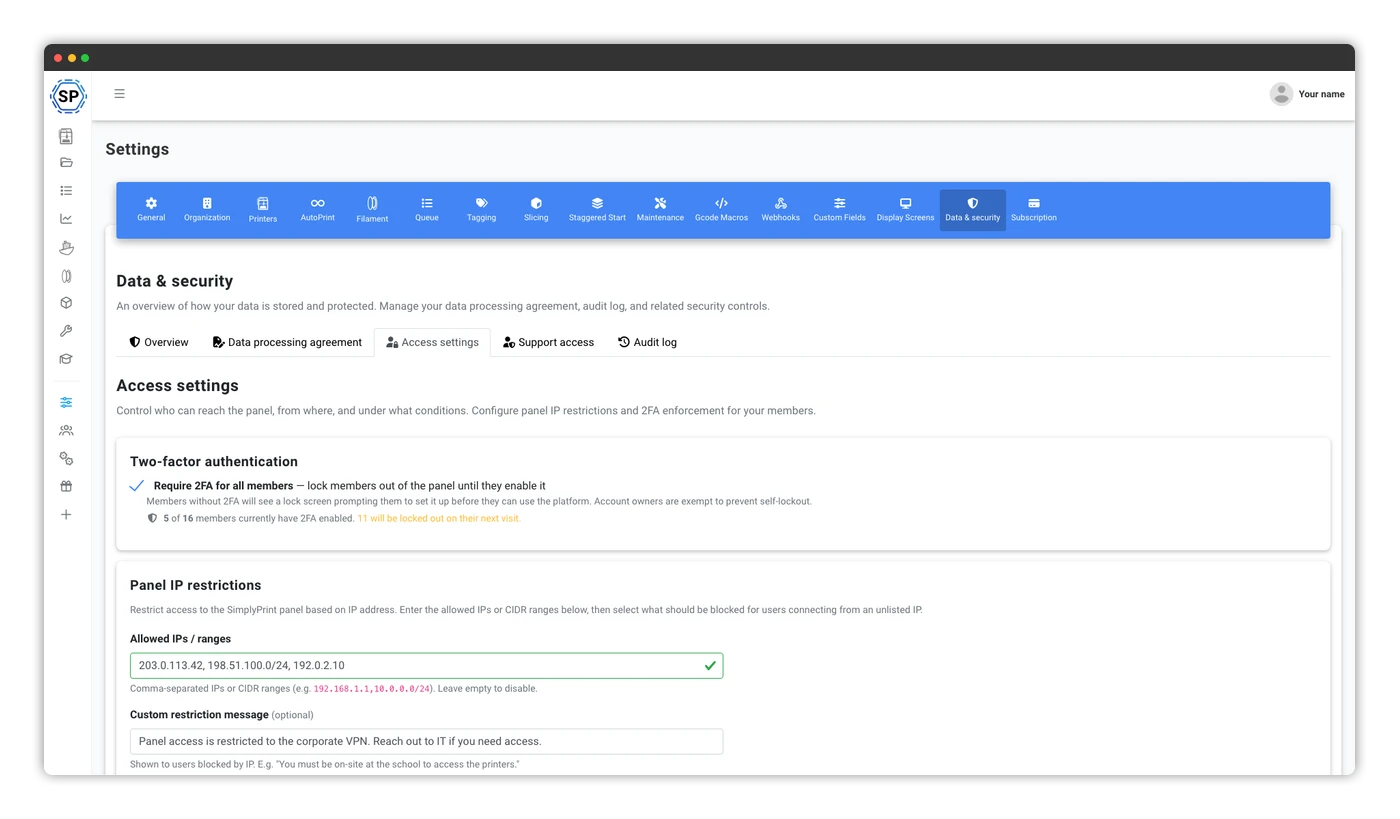
Learn moreRestrict access by IP or CIDR range, require approved devices, and decide which actions are blocked off-network.
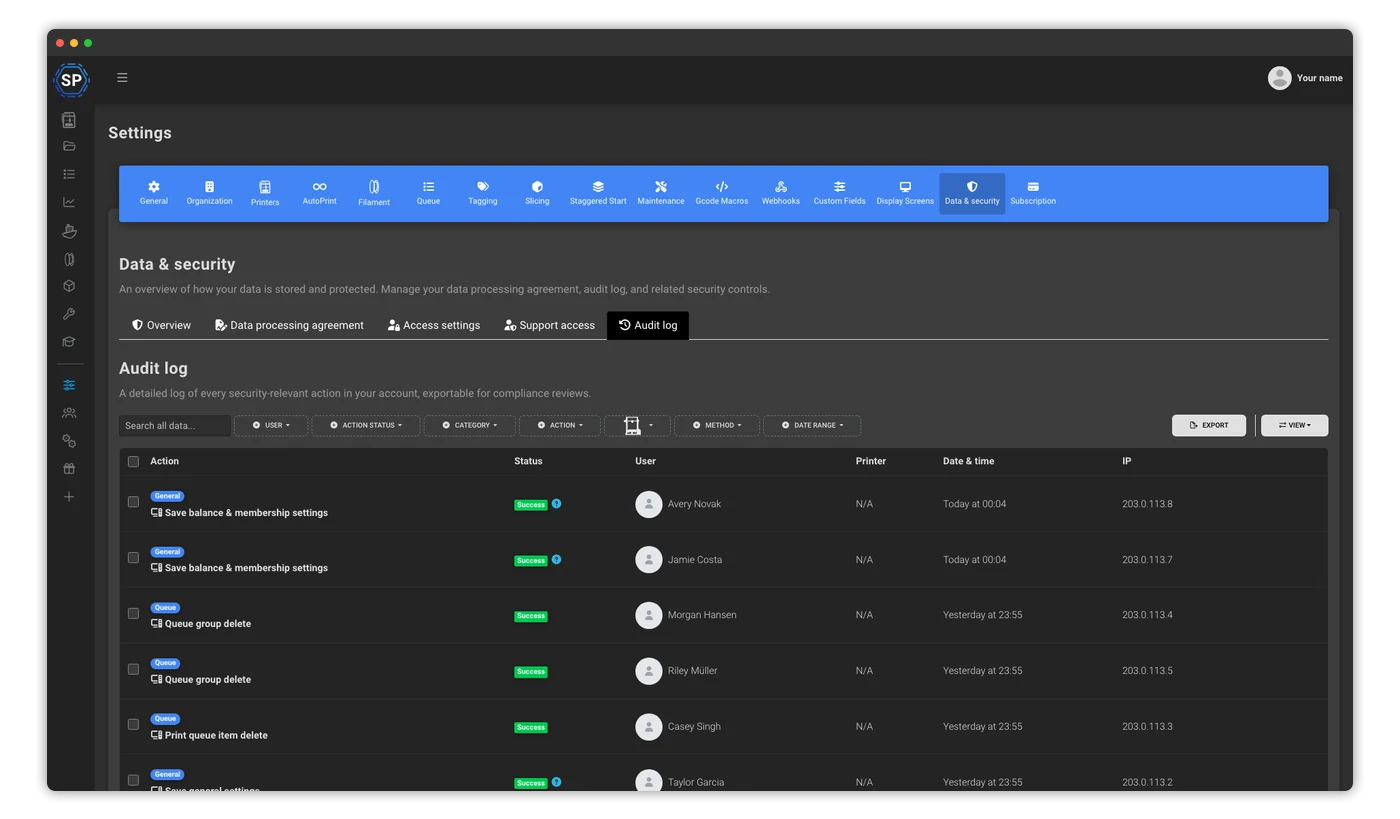
Learn moreReview security-relevant changes by actor, time and IP address, then export the evidence for your own review.
Learn moreAn in-product DPA, a 99.9% uptime SLA for the hosted service and a route for custom legal requirements.
Learn moreA custom deployment can use Docker-based application roles, but it is not a public image download or a free community edition. The Enterprise subscription, implementation, maintenance and support scope remain part of the commercial agreement.
Some capabilities rely on external services. Cloud slicing, AI and other connected features may require an agreed egress path, a different topology or may be unavailable in a disconnected environment.
The hosted Enterprise plan starts at $299/month for the account, with SSO, access controls, audit logs, DPA and the hosted-service SLA. Self-hosted architecture and support are agreed separately.
Book a demo See hosted pricingEvery industry page sits under the same SimplyPrint Enterprise platform; the workflow and deployment questions change.
Bring your fleet, identity, network and deployment requirements. We'll map the platform to the real environment.