We already know your printer and your filament
Because SimplyPrint tracks the spool currently assigned to each extruder and the temperature profile of every material in your Filament Manager, the change-filament flow can heat correctly, eject cleanly, and load the new spool at the right temperature without you typing a single number. The manual change modal itself works on every SimplyPrint-supported printer; auto eject and auto load light up on printers whose firmware exposes the necessary controls (Klipper, Marlin 2.1+, Bambu Lab, Prusa firmware bundle, RepRapFirmware).
Three steps, three big buttons
The whole flow lives in one modal, split into three clear columns. Each step waits for the printer to be ready before unlocking the next, so it's hard to do the wrong thing in the wrong order.
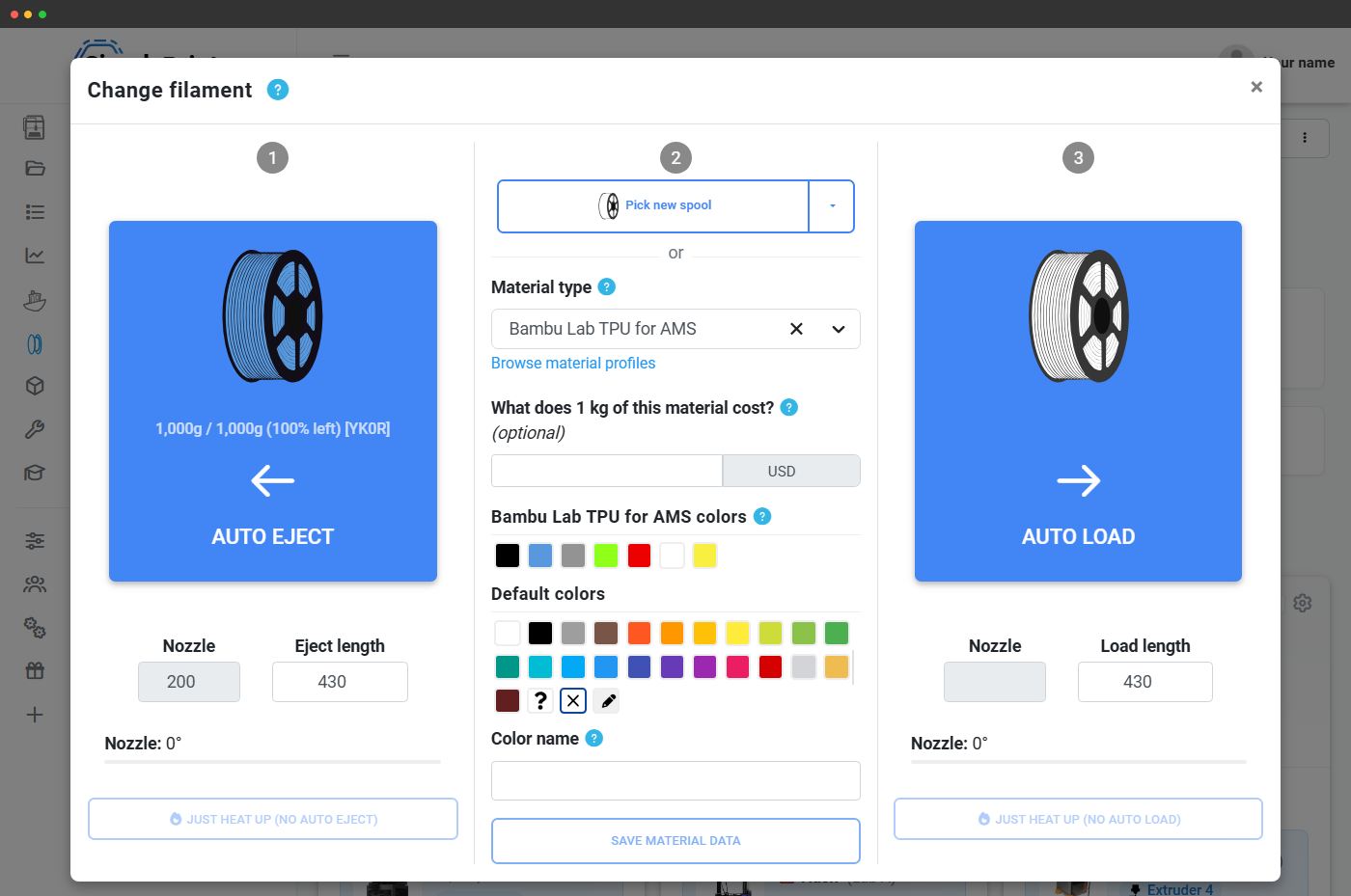
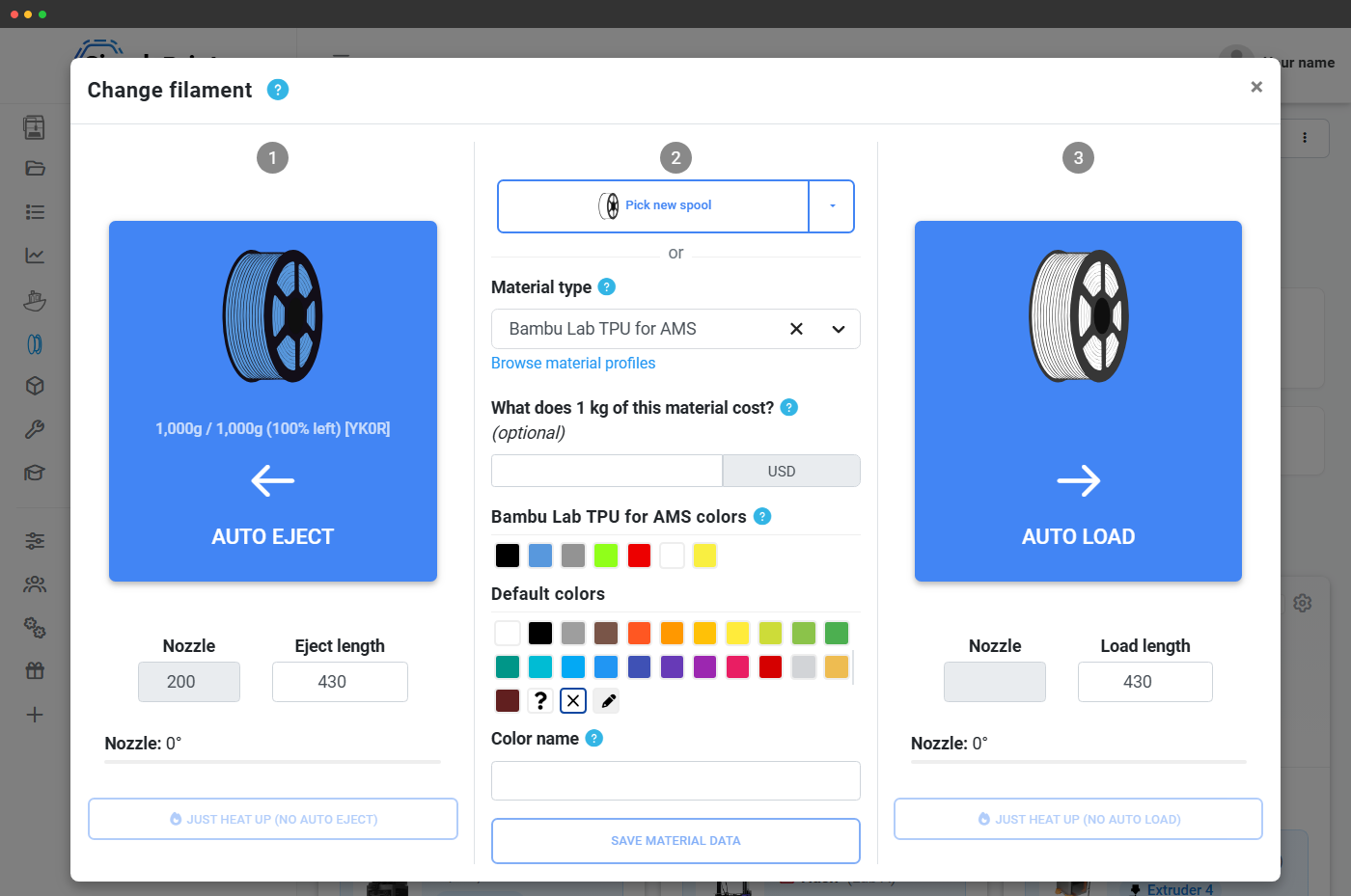
1. Auto eject
Heat to the current material's temp and run the eject G-code.
2. Pick the new spool
Choose from your Filament Manager with colour, brand and weight.
3. Auto load
Heat to the new material's temp, feed and auto-assign the spool.
The temperature is already correct
Every spool in your Filament Manager carries its own nozzle and bed temperature, slicer profile, and material type. When you pick a new spool, the change-filament modal pre-fills the load temperature from that spool - PLA loads at 210, PETG at 240, ASA at 260, whatever you've saved.
Eject uses the currently-loaded material's temperature, so a hot ABS spool ejects at the right temperature even if you're loading cold PLA next. No more melted hotends, no more cold-pulls because someone forgot to preheat.
Multi-extruder, IDEX, AMS and MMU - all in one flow
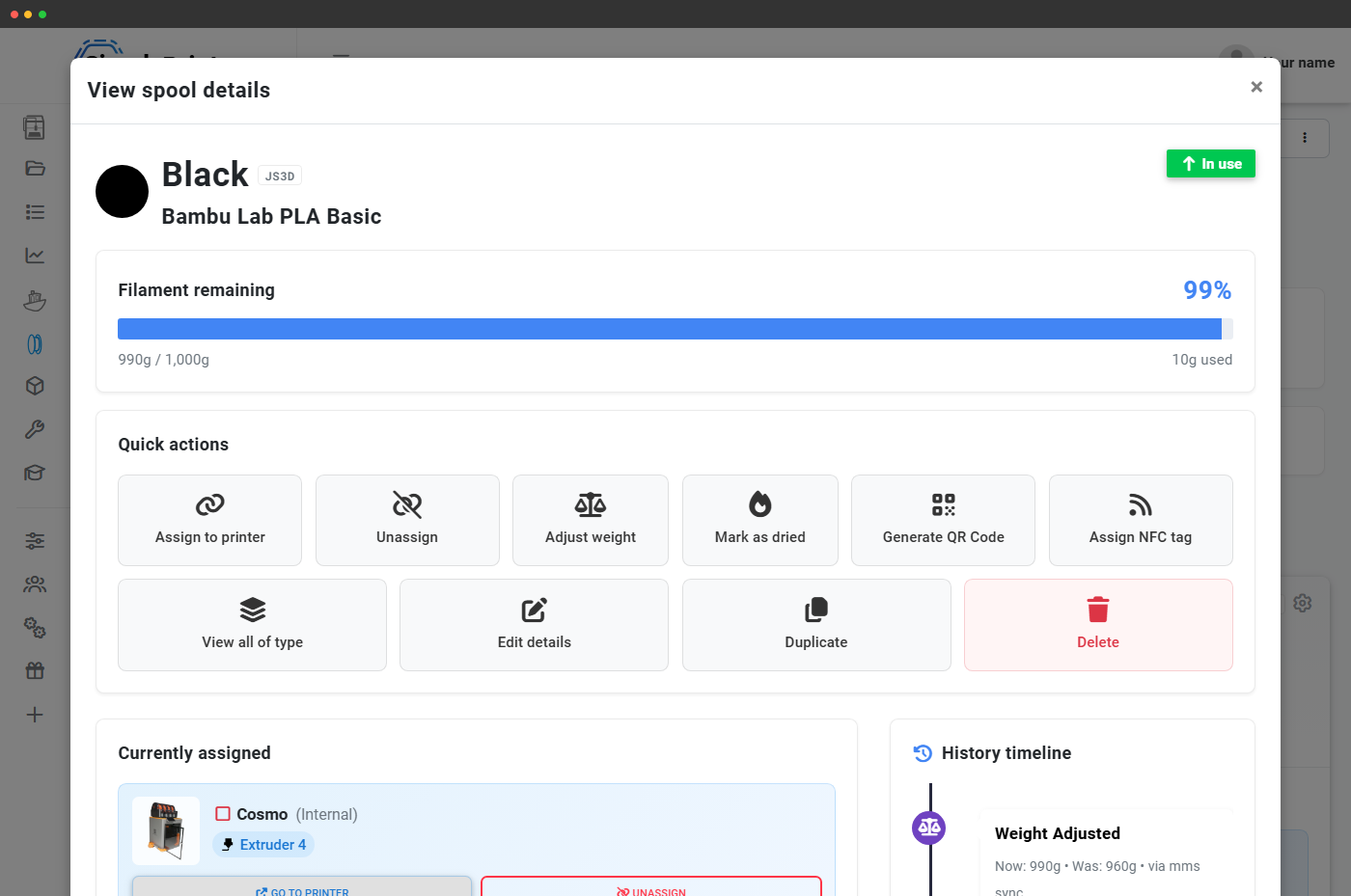
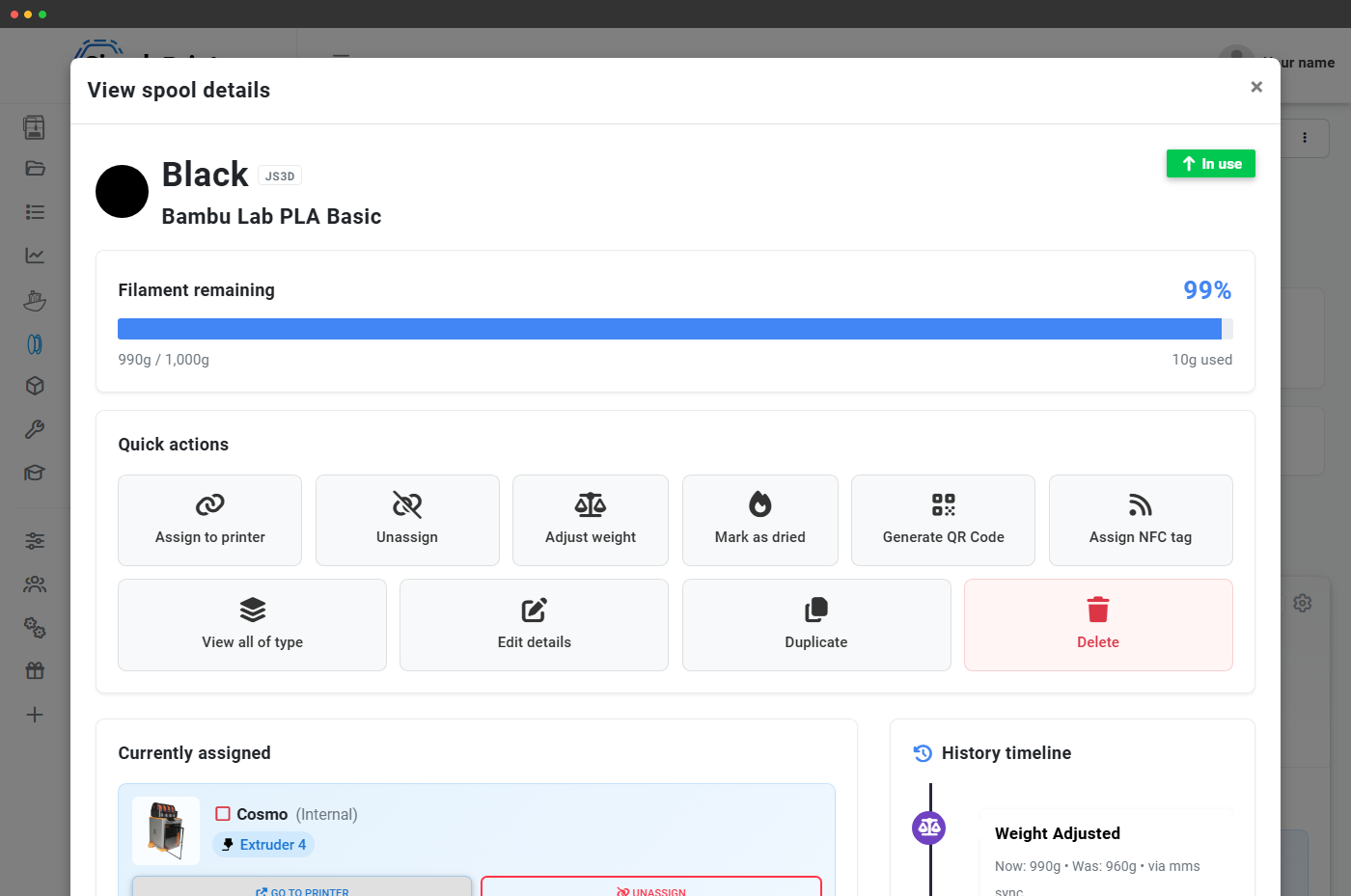
Got a Bambu Lab P1S with AMS? A Prusa XL with five toolheads? A multi-extruder Voron? SimplyPrint detects how many extruders your printer has and shows an extruder selector at the top of the modal. Pick one extruder, several, or all of them, and the eject/pick/load steps apply per-extruder.
Each extruder shows its currently-loaded spool with the correct colour swatch, so you always know which slot you're working with.
Custom lengths and fine-tune buttons for tricky printers
Most printers work great with the default eject and load distances. For long Bowden tubes, oversized hotends, or direct-drive printers with unusual geometry, you can override the eject and load length right in the modal.
Once the hotend is up to temperature, extra +/- 10mm, +/- 50mm and +/- 100mm fine-tune buttons appear so you can nudge filament in or out without leaving the screen - perfect for clearing a stubborn purge or seating a fresh end into the extruder.
We use your firmware's filament-change command when it has one
Klipper, Marlin, RepRapFirmware, Bambu and Prusa firmware all expose filament-change G-code in slightly different ways. SimplyPrint detects what your printer supports and uses the firmware-native command where available, so the printer's own pause-purge-resume routine runs the way the manufacturer designed it.
If your firmware doesn't have a native command, our generic eject/load fallback takes over - meaning the smart filament changer works on every printer SimplyPrint supports, not just the popular ones.
Built-in safety: cool-down prompts and print-state awareness
Close the modal while the hotend is still hot? SimplyPrint asks if you want to cool down first, so you don't accidentally leave a printer at 240C overnight. If the printer is currently mid-print, the cool-down prompt is skipped automatically - obviously.
And because the spool you pick is recorded as the new assignment on that extruder, your next print starts with the right slicing settings, the right cost tracking, and the right filament-runout calculation - automatically.
Change filament from your phone, from across the room, or from anywhere
The change-filament modal is part of the SimplyPrint web panel, so it works from your laptop next to the printer, from your phone while the printer is in the basement, or from a tablet on the farm floor. No SD-card shuffling, no walking-to-the-printer-to-poke-the-LCD.
Plan access: what's required to change filament in SimplyPrint?
The change-filament modal itself is free for everyone. Auto eject and auto load - the parts that heat, push G-code, and let you override lengths - are included on every paid plan.
| Feature / Limit | Free | Basic | Pro | Print Farm | Enterprise | School | Cloud Slicer | Filament Manager |
|---|---|---|---|---|---|---|---|---|
|
Change filament
The three-step modal, spool picker, and extruder selector. Available on every plan, including Free.
|
||||||||
|
Auto eject & auto load
Auto-eject and auto-load with material-aware temperatures, custom lengths, and fine-tune buttons. Included on Basic, Pro, Print Farm, Enterprise and School.
|
||||||||
|
Filament Manager (spool inventory)
Pick from real tracked spools, not just material types. Included on every plan, including Free.
|
Want to learn more about our plans?
View full pricing & feature comparisonFrequently asked questions
Does this work on my specific 3D printer?
Does it work with multi-material systems like Bambu AMS or Prusa MMU?
What if I just want to change filament manually?
Will the next print use the right slicer settings?
How long does the change usually take?
Does it track how much filament is left on the new spool?
What if my printer is currently printing - can I swap mid-print?
M600 command embedded in the G-code that pauses the printer at the right moment so you can swap material. SimplyPrint's change-filament modal is for the between-print swaps that come either side of that pause. SimplyPrint's filament-runout notifications alert you the moment runout is detected so you don't waste time on a stalled print.