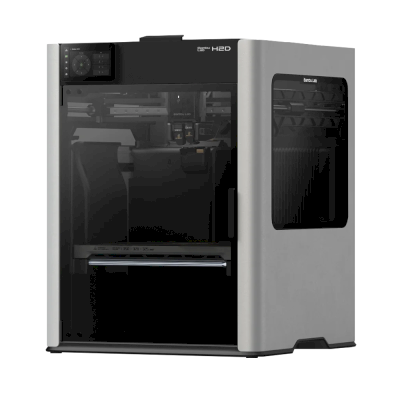
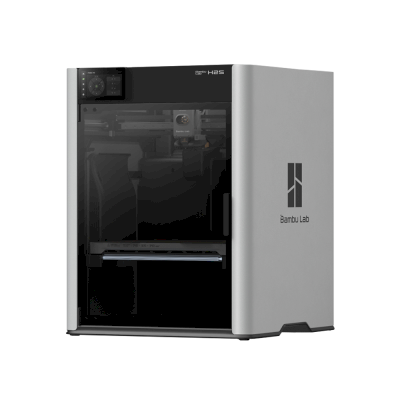
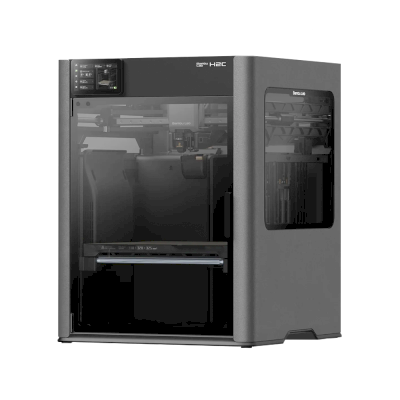
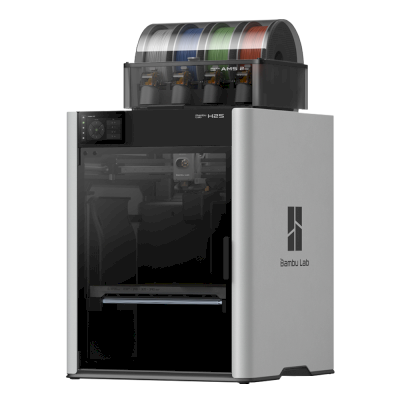
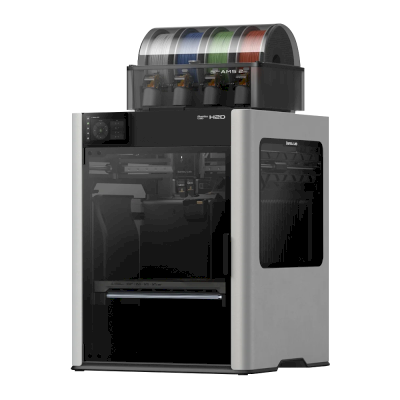
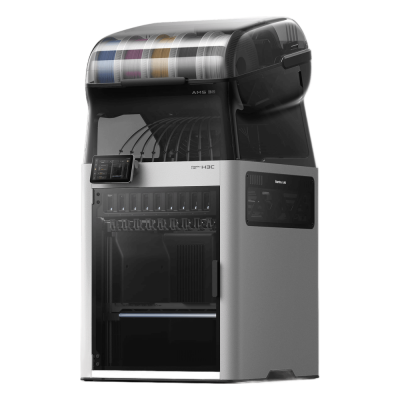
Bambu Lab's first true tool changer: nine PrintTools, each with its own hotend and filament path, swap in about six seconds, with the AMS 3H on top holding all nine spools. It is sold only as the AMS Combo, for people who print a lot of multicolor, mixed-material or soft TPU parts.
Bambu Lab's newest H-series printer, expected to connect through the SimplyPrint Client the same way as the H2C, which SimplyPrint has tested. Not confirmed on the H3C yet.
Tested on firmware that was updated several times during the review: it printed everything from soft TPU to PPS well, swapped nozzles quickly and mixed nozzle sizes in one print. Downsides are the price, a height of over four feet, a clicking stepper motor and one tool's tube catching and dismounting it in long prints. Editor's Choice.
“The Bambu Lab H3C is an excellent nine-tool 3D printer that printed everything we could throw at it.”
After a month of use, the standout is printing with different nozzle sizes and materials in one part, such as PLA walls with TPU infill. Against it: a complex, large and heavy machine, software that takes some working out, and a first calibration of about an hour. Editor's Choice.
“The big innovations here are the ability to print with different nozzle sizes, and while this still feels like a technology in development, the potential is obvious.”
CNC Kitchen · 2026年11月3日
Sponsored by VoxelPLA (disclosed). After almost 400 hours: tool changes of 6-7 seconds against about 40 on the H2C, very good quality, and the best option for soft TPU through the 2.85 mm tool. Drawbacks: the AMS 3H sits high, about 50 mg purged per change, and real-world speed only about 10% above the H2C.
Bambu Lab H3Cを選択するケース
Choose it when you print multicolor or mixed materials often: tool changes take about 6-7 seconds where the H2C needs around 40, and its 2.85 mm tool prints TPU softer than most printers can. If two materials are enough, the H2D costs almost $1,000 less; the H2C handles up to seven filaments for less; and the Snapmaker U1, with four tools, is far cheaper. It is very tall with the AMS 3H on top, so check your shelf and ceiling first.
メリット
Nine tools swap in about six seconds, so multicolor prints are much faster than on a single-nozzle printer.
A dedicated 2.85 mm tool prints very soft TPU.
Different nozzle sizes and materials can be mixed in one print.
Fully enclosed with 65 °C active chamber heating and HEPA and carbon filtration, so ABS, ASA, PC and nylon print well.
Expected to work with SimplyPrint through the SimplyPrint Client, like the H2C.
デメリット
Expensive at $2,499, and sold only as the AMS Combo.
Very tall with the AMS 3H on top, so loading spools can take a step or the Bambu Station.
The AMS 3H dries only two spools at a time.
Wi-Fi only: there is no Ethernet port.
It runs through Bambu Lab's own software and cloud, which some organisations' compliance rules don't allow; connected through SimplyPrint it can be cut off from that and use SimplyPrint's European cloud.
おすすめの対象
学校動作する場合あり
Enclosed and filtered, but expensive, very tall and more complex than a classroom usually needs.
ホビーユーザー適しています
The fastest way to print nine colors or soft TPU at home, if the price and height fit.
企業最適
Engineering materials, mixed nozzle sizes and quick tool changes suit prototypes and multi-material parts.
プリントファーム動作する場合あり
Costly per machine and Wi-Fi only; for identical single-color jobs, cheaper printers do the same work.
Bambu Lab is a Shenzhen company founded in 2020 by former DJI engineers. It makes FDM printers in four families (A, P, X and H), the AMS multi-material units, the Bambu Studio slicer, the Bambu Handy app and the MakerWorld model site, and designs them to be used together. Its printers are used by beginners, hobbyists, schools and print farms.
設立:
2020 ·
本社:
Shenzhen, China ·
所有関係:
Privately held; founded by CEO Ye Tao and other former DJI staff, with venture investors (BGR, 2026) ·
ウェブサイト:bambulab.com
Bambu Lab works like Apple: printer, slicer, app, cloud and multi-material system come from one company and are made to work together. Filament and slicer choice stay open, but the firmware is closed and signed, and since 2025 third-party control needs Bambu Connect or the unsupported Developer Mode.
ファームウェアとカスタムファームウェア ●●●●●
The printer firmware is Bambu's own and closed; in 2022 Bambu said it would keep it in-house. Its security white paper describes secure boot that only runs verified firmware on X1, H2, P1 and A1 printers. Bambu publishes the GPL parts it uses (Linux kernel, U-Boot, BusyBox) but not the printer software. Rooting the X1 only became possible through a security flaw the X1Plus project used in 2024; Bambu then published a one-off rootable X1 firmware for owners who give up their warranty, and blocks rooting in later firmware.
[1][2][3][4][22]
ローカル制御と連携 ●●●●●
LAN Only mode prints and monitors from Bambu Studio or Bambu Connect without internet or an account; the Handy app, printing from outside the network and print history need Bambu's cloud. Since the 2025 authorization firmware, other software can only read status in normal mode. Full control needs Developer Mode, which cuts the cloud link and which Bambu says it cannot support because the protocols are not official. Bambu documents no local protocol; it offers a file hand-off to Bambu Connect and a Local Server SDK on application.
[23][24][6][7][5]
サードパーティー製フィラメント、スライサー、部品 ●●●●●
Third-party filament works, and Bambu publicly denied in 2025 that it would restrict it. OrcaSlicer and other slicers can be used, but since the 2025 firmware they send and control prints through Bambu Connect or Developer Mode. Hotends are Bambu's own designs, and Bambu says it cannot promise long-term support for accessories that control the printer unless it approved them first.
[7][6][4]
修理と交換部品 ●●●●●
Bambu's store sells individual spare parts down to motors, belts, encoders and boards, and its wiki has step-by-step replacement guides for each model (for example the P2S hotend and the H2D/H2C AP board). Many parts, hotends included, are Bambu-specific, so spares come from Bambu.
[8][9][10]
データとプライバシー ●●●●●
Cloud features need a Bambu account, while LAN Only mode keeps jobs on the local network. Bambu publishes a Trust Center and a 38-page security white paper, says it holds ISO/IEC 27001, ISO/IEC 27701 and TRUSTe certifications, and runs a paid bug bounty. In August 2023 a cloud outage made some printers start earlier jobs on their own; Bambu apologised.
[2][11][5][12]
コミュニティとドキュメント ●●●●●
Very large user community, the MakerWorld model site, a detailed wiki and a blog where Bambu explains its policy changes. Bambu Studio is developed in public on GitHub with an open issue tracker. The printer protocol is not documented, and Developer Mode is unsupported.
[13][5][7]
メリット
Printer, slicer, app and AMS come from one company and are designed to work together, which makes a first setup simple.
Step-by-step repair guides for each model and individual spare parts sold in Bambu's store.
LAN Only mode works without internet or an account.
Bambu Studio is open source, and third-party filament works.
Publishes security certifications and runs a public bug bounty.
デメリット
Firmware is closed and signed; current models have no supported way to run custom firmware.
Since the 2025 firmware, third-party software and accessories need Bambu Connect or the unsupported Developer Mode to control the printer.
Remote printing, the Handy app and print history depend on Bambu's cloud.
Hotends and many parts are Bambu-specific, so spares come from Bambu.
In 2026 a US jury found the X1, P1 and A1 infringe Stratasys patents; Bambu is appealing.
実績
9月 2026: A US federal jury in Texas found that Bambu Lab's X1, P1 and A1 printers infringe Stratasys patents on prime towers and bed levelling, and awarded Stratasys $27.6 million. No injunction was placed on the printers. Bambu told Tom's Hardware it disagrees with the verdict and intends to seek post-trial review and appeal. Stratasys had filed two suits in 2024; more patents are still to be decided.
[14]
5月 2026: Bambu Lab pressed the developer of 'OrcaSlicer-bambulab', a fork that restored direct cloud printing from OrcaSlicer, to remove it, according to Manufactur3D. On 7 May Bambu said the fork impersonated the official Bambu Studio client to its cloud, which its user agreement does not allow, and that modifying and sharing its AGPL code remains fine. The developer disputed the claims.
[15][16][17]
10月 2025: Bambu Lab opened a Trust Center with a security white paper and listed ISO/IEC 27001, ISO/IEC 27701 and TRUSTe privacy certifications. A year later it said its bug bounty had worked with over 100 researchers and that it had added a public security update log.
[2][11]
2025年1月20日: After criticism from users and print farms, Bambu Lab announced an optional Developer Mode for X1, P1, A1 and A1 mini that leaves MQTT, FTP and the live stream open for third-party software in LAN mode, without official support. It also said LAN mode via Bambu Connect needs neither internet nor an account, and that third-party filament would not be restricted.
[7]
2025年1月16日: Bambu Lab announced firmware with 'authorization control', first for the X1: starting prints, moving axes, changing temperatures and binding the printer now require Bambu-approved software, also in LAN mode. On updated printers, third-party slicers and accessories such as the Panda Touch could no longer control the printer except through Bambu Connect; reading status still worked. Bambu cited security and up to 30 million unauthorised cloud requests a day; older firmware stayed optional.
[6]
3月 2024: After the X1Plus jailbreak, Bambu Lab published a one-off rootable firmware for the X1 series for owners who give up their warranty support. It said it does not support X1Plus, and that firmware after it would block rooting again.
[4]
2月 2024: Bambu Lab extended its A1 heatbed-cable callback to a recall of all A1 printers and asked owners to stop using them. It reported electrical faults in under 0.1% of units and offered a full refund plus an $80 voucher, or a redesigned heatbed plus a $120 voucher and six extra months of warranty. The A1 mini was not affected.
[18][19]
1月 2024: Community developers rooted the X1 series through a security flaw in its firmware (up to version 1.07) and released the X1Plus custom firmware. Bambu Lab closed the flaw in later firmware.
[22]
8月 2023: During a Bambu cloud outage on 15 August 2023, some printers started print jobs without user action, because jobs stuck in the cloud were resent when service returned. Bambu apologised, took responsibility and said it would add checks before a print starts.
[12]
5月 2022: Before its first printers shipped, Bambu Lab said its firmware would stay closed and in-house to remain competitive, and promised to open-source everything if the company ever could not survive.
[1]
 中国
 SimplyPrintクライアント



 PrusaSlicer
 OrcaSlicer
 ElegooSlicer
 CrealityPrint
 Cura
 Kiri:Moto