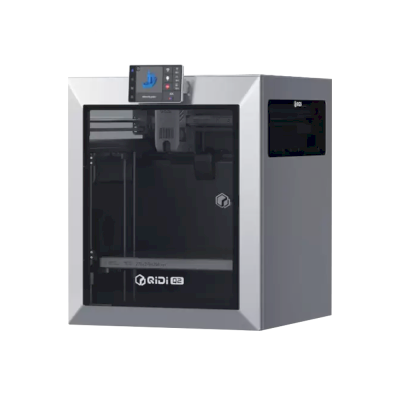
The Q2C is QIDI's entry-level enclosed CoreXY: a 270 x 270 x 256 mm volume, a 370 °C hotend and a 120 °C bed, with automatic levelling through the nozzle and the QIDI Box available for multi-colour. It is for hobbyists and small businesses printing mostly PLA, PETG and TPU.
QIDI runs its own Klipper fork with Moonraker and Fluidd on its printers (QIDI_Q2 repo README); the Q2C shares the Q2's firmware repo (a Q2/Q2C macro PR there) and a third-party guide reports Fluidd and open SSH on the Q2C. Not yet confirmed on a Q2C itself.
ソース
Choose the Q2C for an enclosed, fast and affordable CoreXY for PLA, PETG and TPU. It has no actively heated chamber, so for nylon and PC the QIDI Q2 (with chamber heating) or the Plus5 suit better. The Combo adds the QIDI Box for multi-colour printing. If multi-colour is your main use, a Bambu Lab printer with an AMS is the more common route.
メリット
Enclosed with a full metal CoreXY frame, a 370 °C hardened bimetal hotend and a 120 °C bed (QIDI).
Zero-offset load-cell levelling through the nozzle, a 1.5GT belt and input shaping for clean first layers and smooth walls (QIDI).
Wi-Fi (2.4 GHz), Ethernet and USB, and it is MET certified (QIDI).
Multi-colour with the QIDI Box in the Combo, which can chain up to four boxes (QIDI).
Runs Klipper, and is expected to work with SimplyPrint through Klipper (not yet confirmed).
デメリット
No actively heated chamber, so engineering materials such as nylon and PC are not what it is made for.
No AI camera, and the camera is optional; Wi-Fi is 2.4 GHz only (QIDI).
SimplyPrint compatibility is expected rather than confirmed.
おすすめの対象
学校適しています
Enclosed and simple for PLA and PETG, and SimplyPrint can queue student prints for approval; keep it to PLA and PETG.
ホビーユーザー最適
A low-priced enclosed CoreXY with fast PLA and PETG printing and a multi-colour option.
企業動作する場合あり
Fine for PLA and PETG prototypes, but no heated chamber and no camera limit engineering use.
プリントファーム動作する場合あり
Low price per unit and Klipper, but no camera, 2.4 GHz Wi-Fi and unconfirmed SimplyPrint compatibility weigh on fleets.
QIDI Tech is a Chinese 3D printer maker formed in 2014. It sells enclosed, Klipper-based CoreXY printers such as the compact Q2 and the larger Plus4 and Max4, and develops the open-source QIDI Studio slicer and the QIDI Link app.
QIDI is mostly open: its printers are standard Klipper machines you can run fully on the local network, with published source and plenty of spare parts. The phone app and the store-only privacy policy are the weak spots.
ファームウェアとカスタムファームウェア ●●●●●
QIDI printers run QIDI's editions of Klipper and Moonraker with Fluidd. QIDI publishes them and per-model firmware packages on GitHub under GPL (for example the Q2 in January 2026 and the Max4 in August 2026) and answers issues there.
[1][2][3]
ローカル制御と連携 ●●●●●
QIDI printers run Klipper and Moonraker with Fluidd on the printer, and QIDI Studio connects to them on the local network by IP without an account. QIDI publishes its Moonraker edition on GitHub, and other software can use Moonraker's documented API. Only the QIDI Link phone app needs an account and QIDI's cloud.
[4][5][11][12]
サードパーティー製フィラメント、スライサー、部品 ●●●●●
Third-party filament works; QIDI Studio is open source, and as Klipper and Moonraker printers they work with other Moonraker-compatible software. Hotends and nozzles are QIDI parts made per model.
[6][1][7]
修理と交換部品 ●●●●●
QIDI's store lists many individual parts, including motherboards, eMMC modules, fans, extruders, hotends and Wi-Fi cards, and its wiki has replacement guides such as the Plus4 hotend.
[7][8]
データとプライバシー ●●●●●
Local use needs no account. QIDI Link requires one and says which server it uses (Aliyun in China, AWS elsewhere). The published privacy policy covers the online store, not the printers or the app.
[5][9]
コミュニティとドキュメント ●●●●●
Firmware is released and issues are taken on GitHub, and QIDI keeps a wiki per model with manuals, maintenance and troubleshooting guides.
[1][4]
SimplyPrintからQIDIを実際に使用した経験に基づいています。評価には含まれません。
QIDI is one of the few printer makers we work with directly: they occasionally send us new printers, and put us in touch with their developers when we need them.
メリット
Runs fully on the local network through Fluidd, with no account needed.
Klipper and Moonraker sources and firmware updates are published on GitHub.
Many individual spare parts, down to motherboards and eMMC modules.
Open-source slicer and open filament choice.
デメリット
The QIDI Link app needs an account and QIDI's cloud.
The privacy policy covers only the online store, not the printers or app.
Hotends and nozzles are QIDI-specific parts.
実績
8月 2026: QIDI published the firmware repository for the Max4 on GitHub under GPL-3.0.
[2]
1月 2026: QIDI published the Q2's Klipper-based firmware on GitHub under GPL-3.0, with update packages and an issue tracker.
[1]
 中国

 Klipper (Moonraker)


 PrusaSlicer
 OrcaSlicer
 BambuStudio
 ElegooSlicer
 CrealityPrint
 Cura
 Kiri:Moto



 米国に最適:QIDIの米国向けストア
 EU向けQIDI
 英国向けQIDI