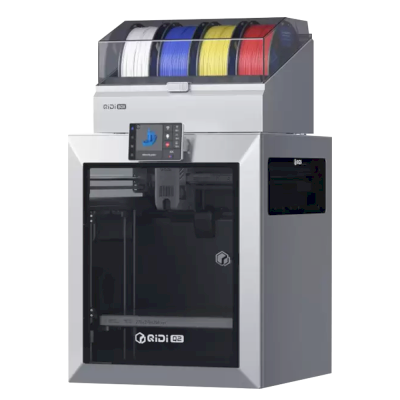
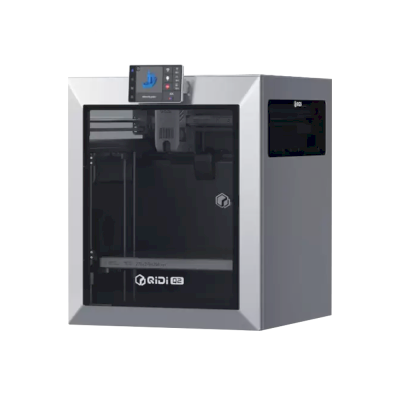
Six months with the single-filament Q2: simple automatic calibration, excellent print reliability and wide material support, suited to education and small businesses. Attaching the Qidi Box was another matter. Recommended.
“Once again, and as I found with previous Qidi machines, the Q2 offers a solid no-fuss approach to 3D printing.”
Tests the Q2 Combo: with a 370°C nozzle, 120°C bed and 65°C heated chamber it handles high-temperature filaments well, and the QIDI Box dries filament. But the multi-material box jammed repeatedly from filament-path friction even with a printed riser; QIDI said theirs was an early unit.
“At the time of this review, the QIDI Box is a great filament dryer, but not much else.”
Aurora Tech · 2026年5月26日
Ten-month test of the Q2 Combo: the box works as a dryer and four-spool backup, but multicolor PLA is slow and wasteful, so he would not buy it for that. A good, cheap choice for engineering filaments. Sponsored by Qidi, sent the unit (disclosed).
ModBot · 2025年12月27日
Months of use of the Q2 and Qidi Box: the first box needed work and the revised one is still noisy when loading, but it saves time managing spools and gives filament backup. At 499 dollars (649 with the box) he finds it very competitive and a go-to for demanding filaments.
Made with Layers · 2025年9月15日
Finds stock print profiles produced visible artifacts until Qidi sent a slower tweaked file; calls the Q2 'the Linux of 3D printers' with an accessible Klipper base and good documentation. The Qidi Box is fine as a dryer but not for many color swaps; he would skip it.
QIDI Tech is a Chinese 3D printer maker formed in 2014. It sells enclosed, Klipper-based CoreXY printers such as the compact Q2 and the larger Plus4 and Max4, and develops the open-source QIDI Studio slicer and the QIDI Link app.
QIDI is mostly open: its printers are standard Klipper machines you can run fully on the local network, with published source and plenty of spare parts. The phone app and the store-only privacy policy are the weak spots.
ファームウェアとカスタムファームウェア ●●●●●
QIDI printers run QIDI's editions of Klipper and Moonraker with Fluidd. QIDI publishes them and per-model firmware packages on GitHub under GPL (for example the Q2 in January 2026 and the Max4 in August 2026) and answers issues there.
[1][2][3]
ローカル制御と連携 ●●●●●
QIDI printers run Klipper and Moonraker with Fluidd on the printer, and QIDI Studio connects to them on the local network by IP without an account. QIDI publishes its Moonraker edition on GitHub, and other software can use Moonraker's documented API. Only the QIDI Link phone app needs an account and QIDI's cloud.
[4][5][11][12]
サードパーティー製フィラメント、スライサー、部品 ●●●●●
Third-party filament works; QIDI Studio is open source, and as Klipper and Moonraker printers they work with other Moonraker-compatible software. Hotends and nozzles are QIDI parts made per model.
[6][1][7]
修理と交換部品 ●●●●●
QIDI's store lists many individual parts, including motherboards, eMMC modules, fans, extruders, hotends and Wi-Fi cards, and its wiki has replacement guides such as the Plus4 hotend.
[7][8]
データとプライバシー ●●●●●
Local use needs no account. QIDI Link requires one and says which server it uses (Aliyun in China, AWS elsewhere). The published privacy policy covers the online store, not the printers or the app.
[5][9]
コミュニティとドキュメント ●●●●●
Firmware is released and issues are taken on GitHub, and QIDI keeps a wiki per model with manuals, maintenance and troubleshooting guides.
[1][4]
SimplyPrintからQIDIを実際に使用した経験に基づいています。評価には含まれません。
QIDI is one of the few printer makers we work with directly: they occasionally send us new printers, and put us in touch with their developers when we need them.
メリット
Runs fully on the local network through Fluidd, with no account needed.
Klipper and Moonraker sources and firmware updates are published on GitHub.
Many individual spare parts, down to motherboards and eMMC modules.
Open-source slicer and open filament choice.
デメリット
The QIDI Link app needs an account and QIDI's cloud.
The privacy policy covers only the online store, not the printers or app.
Hotends and nozzles are QIDI-specific parts.
実績
8月 2026: QIDI published the firmware repository for the Max4 on GitHub under GPL-3.0.
[2]
1月 2026: QIDI published the Q2's Klipper-based firmware on GitHub under GPL-3.0, with update packages and an issue tracker.
[1]
 中国
 Klipper (Moonraker)



 PrusaSlicer
 BambuStudio
 CrealityPrint
 Cura
 Kiri:Moto




 米国に最適:QIDIの米国向けストア
 EU向けQIDI
 英国向けQIDI