The K3 is Creality's nozzle-changing CoreXY: four 0.4 mm hardened steel nozzles that swap in 4.8 seconds, for four colours or materials with little purge waste. It is for hobbyists and small makers who want fast, low-waste multi-colour printing, and it is still a pre-order.
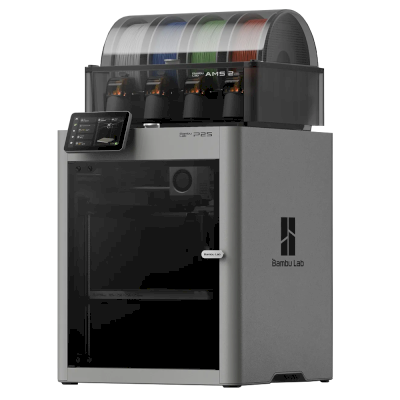
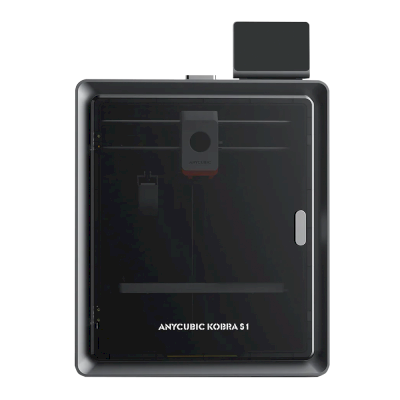
Choose the K3 if multi-colour waste and colour-change time are your main costs and you are happy to buy before reviews exist: Creality's own FAQ lists a 4.8 second nozzle change, 15 seconds for a colour or material change and an expected launch price below $900. Treat every figure as Creality's own claim. It is semi-enclosed, with an optional top cover that seals the chamber and adds a HEPA and carbon filter. For a similar tool changer with reviews, look at the Flashforge Creator 5; for a single-nozzle printer with a proven AMS, the Bambu Lab P2S.
メリット
Four nozzles and four spool slots for waste-free four-colour or multi-material printing out of the box (Creality).
A 4.8 second nozzle change and 15 seconds for a colour or material change, tested over 800,000 changes (Creality).
Mixed nozzle sizes are a core feature, with 0.2, 0.6 and 0.8 mm nozzles sold in a separate kit (Creality).
95A TPU out of the box, softer TPU with an optional kit, and a CFS Hub to add more colours (Creality).
Klipper-based firmware released in phases, root access out of the box, and Orca Slicer works with it (Creality). Expected to work with SimplyPrint through Klipper or the SimplyPrint Client.
デメリット
A pre-order with no independent review, and its speed and waste figures are Creality's own claims.
Only partly enclosed: the chamber seal and HEPA and carbon filter come with an optional top cover (Creality).
Mixed nozzle sizes and softer TPU need extra kits sold separately (Creality).
Complex nozzle-swapping hardware is new and unproven over long runs.
おすすめの対象
学校動作する場合あり
Multi-colour prints engage students and SimplyPrint can hold them for approval, but a hot, partly open machine with new hardware needs supervision.
ホビーユーザー適しています
Low-waste, fast four-colour printing with a modifiable Klipper base, though untested by reviewers.
企業動作する場合あり
Efficient multi-material prototypes, but new, partly open and unreviewed.
プリントファーム動作する場合あり
Little waste per colour print and Klipper helps remote control, but new nozzle hardware has no track record for unattended fleets.
Creality is a Shenzhen 3D printer maker founded in 2014. Its low-cost Ender series, launched in 2017, made desktop 3D printing affordable for many hobbyists. It now sells Klipper-based K-series CoreXY printers, Ender and CR open-frame printers, the Hi and SPARKX beginner lines, the CFS multi-material system, 3D scanners and laser engravers, and runs the Creality Cloud model platform. It listed on the Hong Kong Stock Exchange in 2026.
設立:
2014 ·
本社:
Shenzhen, China ·
所有関係:
Listed on the Hong Kong Stock Exchange (3388.HK) since 2026; founder Jack Chen is chief executive ·
ウェブサイト:www.creality.com
Creality sits in the middle: its Klipper-based printers can be run locally with Fluidd and open slicers, and it publishes firmware source, but usually months after launch, and it dropped root access on its 2025 K1 revisions.
ファームウェアとカスタムファームウェア ●●●●●
Creality publishes Klipper firmware source for the K1, K2, Hi and Ender-3 V3 KE on GitHub under GPL, but after launch: the K1 source came about three months after the series launched in May 2023, the K2 and Hi sources in September 2025. Earlier K1 printers have an official root option with a published guide, but Creality's wiki says the 2025 K1C and K1 Max do not support root access.
[1][2][3][4][5]
ローカル制御と連携 ●●●●●
Creality Print sends jobs over the local network with no account, and Creality Cloud is optional. The K2 series and Ender-3 V3 serve Fluidd on the printer, so other software can use Klipper's documented Moonraker API. On the K1 series, Creality's firmware notes treat Fluidd and Mainsail as add-ons owners install themselves, and Creality says the 2025 K1C and K1 Max do not support root access. The SPARKX i7 is set up through the Creality Cloud app.
[6][20][7][21][4][8][22]
サードパーティー製フィラメント、スライサー、部品 ●●●●●
Third-party filament works; Creality Print is an open-source (AGPL-3.0) slicer and OrcaSlicer supports Creality printers. Creality sells nozzle, hotend and extruder kits per model; newer K2 parts such as its nozzle kit are Creality designs.
[10][11][12]
修理と交換部品 ●●●●●
Creality's store sells extruder, hotend, heating-block and print-head kits per model, and its wiki has parts lists and replacement guides for current printers (for example the K2 Plus and SPARKX i7 hotends).
[12][13][14]
データとプライバシー ●●●●●
Local printing needs no account; Creality Cloud and its app need one. Creality's published privacy policy is written for its websites and services, allows use of data for targeted advertising, and says little about printer data or where it is stored.
[15][6]
コミュニティとドキュメント ●●●●●
One of the largest user bases (second in consumer 3D printers by 2025 sales value, per figures in its listing), a public wiki with model-specific guides, firmware and slicer sources on GitHub, and an official forum.
[16][10][6]
メリット
Klipper-based models can be run entirely on the local network through Fluidd, without an account.
Firmware for most current models and the Creality Print slicer are published as source on GitHub.
Wide range, from budget Ender printers to multi-colour K2 machines.
Spare-part kits and model-specific replacement guides are easy to find.
Very large user base, so community help is easy to find.
デメリット
Firmware source has usually appeared months after a model ships.
Root access, offered on earlier K1 printers, is not supported on the 2025 K1C and K1 Max.
The privacy policy says little about printer and cloud data.
The SPARKX line is built around the Creality Cloud app and an account.
実績
5月 2026: Creality listed on the Main Board of the Hong Kong Stock Exchange (3388.HK), raising about HK$1.27 billion net. Its prospectus showed 2025 revenue of RMB 3.13 billion and a net loss of RMB 182.4 million, after a profit in 2024.
[16][5]
11月 2025: Creality's wiki states that the 2025 revisions of the K1C and K1 Max do not support root access, which earlier K1 printers offered through an official option and guide.
[4][17][3]
9月 2025: Creality published the Klipper source for its K2 series and for the Hi on GitHub under GPL-3.0.
[2][18]
8月 2023: About three months after the K1 series launched, Creality published its K1 Klipper source on GitHub, followed by a repository with a root guide and Fluidd and Mainsail install instructions.
[1][3][5]
 中国

 SimplyPrintクライアント
 Klipper (Moonraker)



 PrusaSlicer
 OrcaSlicer
 BambuStudio
 ElegooSlicer
 Cura
 Kiri:Moto



 カナダ向けCreality