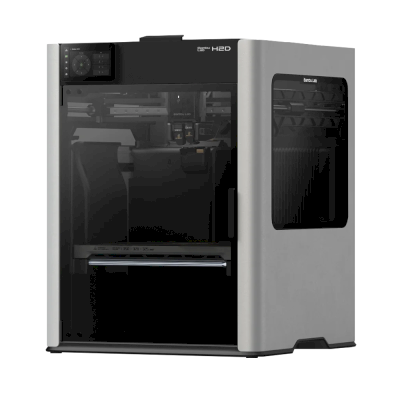
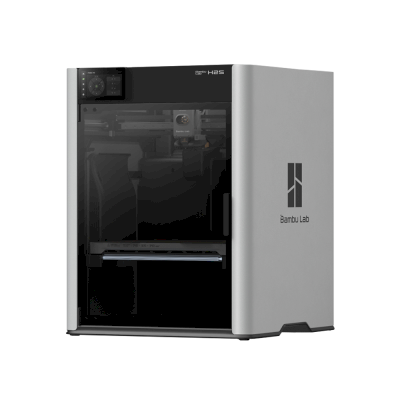
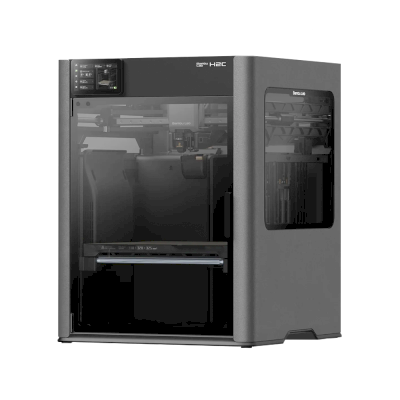
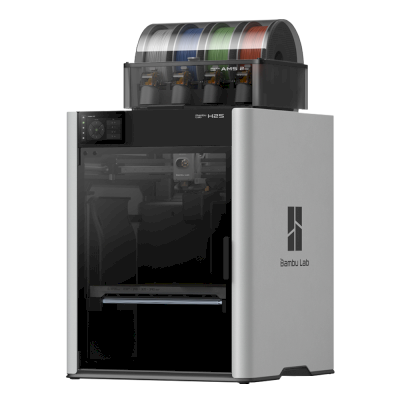
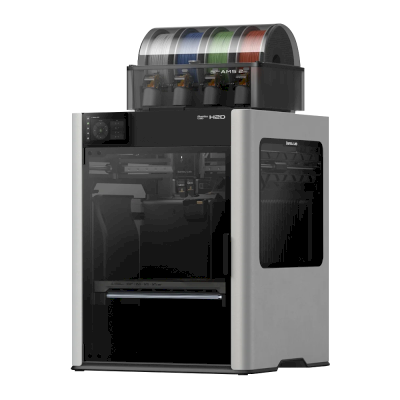
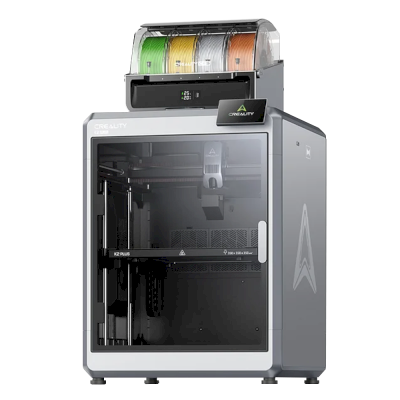
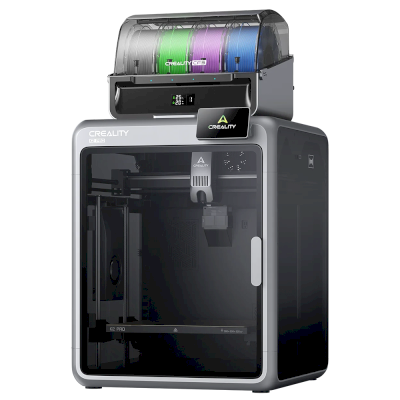
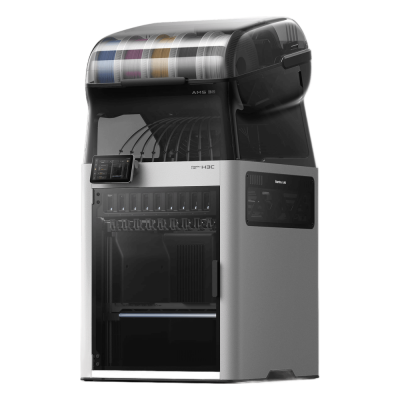
Bambu Lab's first true tool changer: nine PrintTools, each with its own hotend and filament path, swap in about six seconds, with the AMS 3H on top holding all nine spools. It is sold only as the AMS Combo, for people who print a lot of multicolor, mixed-material or soft TPU parts.
La stampante 3D Bambu Lab H3C è compatibile con SimplyPrint, OctoPrint, Mainsail e Fluidd?
Ogni modalità di connessione, requisiti e configurazione.
SimplyPrint Client
Dovrebbe funzionare
Bambu Lab's newest H-series printer, expected to connect through the SimplyPrint Client the same way as the H2C, which SimplyPrint has tested. Not confirmed on the H3C yet.
Collegata tramite SimplyPrint Client in modalità solo LAN, SimplyPrint dovrebbe supportare tutto ciò che Bambu Lab H3C consente ad altri software di fare: la fotocamera e il rilevamento degli errori tramite IA, stampa remota, esclusione degli oggetti, controllo di temperatura e movimento, mappatura del filamento per l'unità multi-materiale e AutoPrint. Le uniche eccezioni sono le funzioni che Bambu Lab H3C non consente ad altri software di usare: Baby stepping, Livellamento del piano e Calibrazione Z-offset. La tabella seguente confronta i due modi per collegarla a SimplyPrint.
Ogni funzionalità di SimplyPrint, per ogni modalità di connessione a SimplyPrint
Collegata a SimplyPrint tramite
funzione di SimplyPrint
SimplyPrint Client (Modalità solo LAN, consigliata)
Dovrebbe funzionare
Sincronizzare il filamento caricato dall'unità multimateriale
Sì3
Sì3
Automazione
AutoPrint
Pro
Sì
Dipende1
Scaricare il file prima dell'avvio della stampa
Sì
Non offerto dalla stampante2
Collegata a SimplyPrint tramite SimplyPrint Client (Modalità solo LAN, consigliata)
Dovrebbe funzionare
Monitoraggio
Stato e avanzamento in tempo realeSì
WebcamSì
Rilevamento errori con IASì
Tempo rimanenteSì
Avanzamento dei layerSì
TemperatureSì
Stampa
Avvio della stampaSì
Mettere in pausa, riprendere e annullareSì
Ignorare oggettiSì
Opzioni di avvio della stampaSì
File
Stampare file 3MF sezionatiSì
Controllo della stampante
Modificare le temperatureSì
Movimento con i comandiSì
Ritorno all'origineSì
Estrudere e retrarreSì
Modificare la velocità di stampaSì
Velocità ventolaSì
Baby steppingNon offerto dalla stampante2
Inviare G-codeSì
Calibrazione
Cambio filamentoSì
Livellamento del pianoNon offerto dalla stampante2
Calibrazione Z-offsetNon offerto dalla stampante2
Multimateriale
Associare filamento agli slot multi-materialeSì3
Sincronizzare il filamento caricato dall'unità multimaterialeSì3
Automazione
AutoPrint ProSì
Scaricare il file prima dell'avvio della stampaSì
Collegata a SimplyPrint tramite SimplyPrint Client (Modalità cloud)
Dovrebbe funzionare
Monitoraggio
Stato e avanzamento in tempo realeSì
WebcamSì
Rilevamento errori con IASì
Tempo rimanenteSì
Avanzamento dei layerSì
TemperatureSì
Stampa
Avvio della stampaDipende1
Mettere in pausa, riprendere e annullareDipende1
Ignorare oggettiDipende1
Opzioni di avvio della stampaDipende1
File
Stampare file 3MF sezionatiSì
Controllo della stampante
Modificare le temperatureSì
Movimento con i comandiDipende1
Ritorno all'origineDipende1
Estrudere e retrarreDipende1
Modificare la velocità di stampaDipende1
Velocità ventolaDipende1
Baby steppingNon offerto dalla stampante2
Inviare G-codeDipende1
Calibrazione
Cambio filamentoDipende1
Livellamento del pianoNon offerto dalla stampante2
Calibrazione Z-offsetNon offerto dalla stampante2
Multimateriale
Associare filamento agli slot multi-materialeSì3
Sincronizzare il filamento caricato dall'unità multimaterialeSì3
Automazione
AutoPrint ProDipende1
Scaricare il file prima dell'avvio della stampaNon offerto dalla stampante2
Funziona
Dipende
Non supportato
Non offerto dalla stampante
Il firmware Bambu Lab dal 2025 consente il monitoraggio solo in modalità cloud: usare la modalità solo LAN per avviare le stampe e controllare la stampante. I firmware precedenti consentono ancora entrambe le modalità.
La stampante non offre questa funzione ad altri software.
Richiede un'unità multimateriale
Quale slicer usare per la Bambu Lab H3C
Le stampanti Bambu Lab usano BambuStudio, lo slicer proprietario di Bambu Lab. Non è ancora disponibile nel cloud un profilo predefinito per Bambu Lab H3C.
Sono elencati solo gli slicer utilizzabili nel cloud di SimplyPrint, potrebbero quindi essercene altri per Bambu Lab H3C.
Slicer cloud per Bambu Lab H3C: usare BambuStudio online
Usare BambuStudio e altri slicer, direttamente nel browser con lo slicer cloud online di SimplyPrint. Non richiede installazione. Sezionare i modelli Bambu Lab H3C da qualsiasi dispositivo, ovunque nel mondo.
Aggiornamenti automatici dei profili: i profili vengono verificati e recuperati automaticamente ogni giorno dai repository GitHub degli slicer, oltre che dal nostro database open source di profili slicer gestito dalla community. Questo garantisce sempre l'accesso ai profili più recenti.
Nota: Altri slicer, come Simplify3D, ideaMaker, SuperSlicer e KISSlicer, non sono nel nostro cloud, quindi i relativi profili non vengono monitorati. Potrebbero comunque funzionare bene con Bambu Lab H3C: consultare la documentazione o i forum dello slicer per un profilo. È inoltre possibile contribuire con profili al nostro database open source dei profili slicer su GitHub.
L'app per Bambu Lab H3C
SimplyPrint funge da app per Bambu Lab H3C: sul telefono e in qualsiasi browser, con uno slicer nel cloud.
Cosa si ottiene con SimplyPrint
Un'app per iPhone e Android, accessibile da qualsiasi browser, e uno slicer nel cloud.
Più del monitoraggio: coda di stampa, rilevamento guasti con IA, AutoPrint e account per un team.
Stampanti di molti marchi in un unico posto, affiancate.
Non esiste ancora un dispositivo di sostituzione della piastra o un kit di espulsione automatica per la Bambu Lab H3C in SimplyPrint, ma AutoPrint può comunque mantenerla operativa: quando la piastra è libera, avvia il lavoro successivo dalla coda.
Le stampanti chiuse espellono le stampe
Il piano di stampa della stampante Bambu Lab H3C si muove solo su e giù all'interno della sua camera chiusa, quindi, invece di sostituire le piastre, kit come questi consentono alla testa di stampa di spingere la stampa raffreddata fuori dalla piastra e dalla porta frontale, che aprono automaticamente al termine di una stampa.
Spingere via le stampe con la testa di stampaSu una stampante CoreXY, una routine G-code può spingere la stampa raffreddata fuori dal davanti del piano di stampa prima dell'avvio del lavoro successivo.
Sì
Opzioni disponibili: Use AMS, Bed Leveling, Flow Calibration, Timelapse
La stampante
Produttore / marca della stampante
Bambu Lab
Nome del modello di stampante
H3C
Prodotto da un'azienda di
Cina
Lanciato
3 novembre 2026
Ancora in produzione
Sì
Avviso legale:
Ci impegniamo a mantenere queste informazioni il più aggiornate e accurate possibile, ma non possiamo garantirne la completezza o l'affidabilità. I dati si basano su segnalazioni degli utenti e riferimenti dei produttori.
Quale filamento può stampare Bambu Lab H3C?
Compatibilità dei filamenti per Bambu Lab H3C: materiali indicati da Bambu Lab.
Filamento
Idoneità
Note
PLA
Ottimo
Nell'elenco dei materiali del produttore per questa stampante.
PETG
Ottimo
Nell'elenco dei materiali del produttore per questa stampante.
TPU e flessibili
Ottimo
Nell'elenco dei materiali del produttore per questa stampante.
ABS & ASA
Ottimo
Nell'elenco dei materiali del produttore per questa stampante.
Nylon (PA)
Ottimo
Nell'elenco dei materiali del produttore per questa stampante.
Polycarbonate (PC)
Ottimo
Nell'elenco dei materiali del produttore per questa stampante.
Con fibra di carbonio e vetro
Ottimo
Nell'elenco dei materiali del produttore per questa stampante.
Alta temperatura (PEI, PEEK, PEKK)
Ottimo
Nell'elenco dei materiali del produttore per questa stampante.
Suggerimento: questa è una guida generale basata sulle specifiche della stampante. Controlla sempre le impostazioni consigliate per il filamento. Con SimplyPrint puoi salvare un profilo per ogni bobina e tracciare con precisione il filamento disponibile.
Miglior filamento per Bambu Lab H3C
Filamenti stampati bene da Bambu Lab H3C, prima quelli di Bambu Lab, poi i più noti.
Tested on firmware that was updated several times during the review: it printed everything from soft TPU to PPS well, swapped nozzles quickly and mixed nozzle sizes in one print. Downsides are the price, a height of over four feet, a clicking stepper motor and one tool's tube catching and dismounting it in long prints. Editor's Choice.
“The Bambu Lab H3C is an excellent nine-tool 3D printer that printed everything we could throw at it.”
After a month of use, the standout is printing with different nozzle sizes and materials in one part, such as PLA walls with TPU infill. Against it: a complex, large and heavy machine, software that takes some working out, and a first calibration of about an hour. Editor's Choice.
“The big innovations here are the ability to print with different nozzle sizes, and while this still feels like a technology in development, the potential is obvious.”
CNC Kitchen · 3 novembre 2026
Sponsored by VoxelPLA (disclosed). After almost 400 hours: tool changes of 6-7 seconds against about 40 on the H2C, very good quality, and the best option for soft TPU through the 2.85 mm tool. Drawbacks: the AMS 3H sits high, about 50 mg purged per change, and real-world speed only about 10% above the H2C.
Quando scegliere Bambu Lab H3C
Choose it when you print multicolor or mixed materials often: tool changes take about 6-7 seconds where the H2C needs around 40, and its 2.85 mm tool prints TPU softer than most printers can. If two materials are enough, the H2D costs almost $1,000 less; the H2C handles up to seven filaments for less; and the Snapmaker U1, with four tools, is far cheaper. It is very tall with the AMS 3H on top, so check your shelf and ceiling first.
Vantaggi
Nine tools swap in about six seconds, so multicolor prints are much faster than on a single-nozzle printer.
A dedicated 2.85 mm tool prints very soft TPU.
Different nozzle sizes and materials can be mixed in one print.
Fully enclosed with 65 °C active chamber heating and HEPA and carbon filtration, so ABS, ASA, PC and nylon print well.
Expected to work with SimplyPrint through the SimplyPrint Client, like the H2C.
Svantaggi
Expensive at $2,499, and sold only as the AMS Combo.
Very tall with the AMS 3H on top, so loading spools can take a step or the Bambu Station.
The AMS 3H dries only two spools at a time.
Wi-Fi only: there is no Ethernet port.
It runs through Bambu Lab's own software and cloud, which some organisations' compliance rules don't allow; connected through SimplyPrint it can be cut off from that and use SimplyPrint's European cloud.
A chi è adatto
ScuolePuò funzionare
Enclosed and filtered, but expensive, very tall and more complex than a classroom usually needs.
HobbistiBuona compatibilità
The fastest way to print nine colors or soft TPU at home, if the price and height fit.
AziendeOttima compatibilità
Engineering materials, mixed nozzle sizes and quick tool changes suit prototypes and multi-material parts.
Farm di stampaPuò funzionare
Costly per machine and Wi-Fi only; for identical single-color jobs, cheaper printers do the same work.
Stampanti dello stesso produttore, di dimensioni simili, che stampano gli stessi materiali tecnici o multimateriale, acquistabili oggi. È possibile confrontarne fino a quattro affiancate, con specifiche e modalità di connessione.
Anche di Bambu Lab · Volume di stampa simile · Stampa anche ABS & ASA, Nylon (PA), Polycarbonate (PC), Con fibra di carbonio e vetro, Alta temperatura (PEI, PEEK, PEKK) · Anche multimateriale
Anche di Bambu Lab · Volume di stampa simile · Stampa anche ABS & ASA, Nylon (PA), Polycarbonate (PC), Con fibra di carbonio e vetro, Alta temperatura (PEI, PEEK, PEKK) · Anche multimateriale
Chi produce Bambu Lab H3C e quanto margine di libertà offre Bambu Lab: se le sue stampanti funzionano senza il suo cloud, accettano qualsiasi filamento e slicer e possono essere riparate. Ogni aspetto è valutato su fonti pubbliche.
Apertura: Per lo più chiusa (2.3 su 5)
Per lo più chiusa
Sistema chiusoAperto
Bambu Lab is a Shenzhen company founded in 2020 by former DJI engineers. It makes FDM printers in four families (A, P, X and H), the AMS multi-material units, the Bambu Studio slicer, the Bambu Handy app and the MakerWorld model site, and designs them to be used together. Its printers are used by beginners, hobbyists, schools and print farms.
Fondata:
2020 ·
Sede centrale:
Shenzhen, China ·
Proprietà:
Privately held; founded by CEO Ye Tao and other former DJI staff, with venture investors (BGR, 2026) ·
Sito web:bambulab.com
Bambu Lab works like Apple: printer, slicer, app, cloud and multi-material system come from one company and are made to work together. Filament and slicer choice stay open, but the firmware is closed and signed, and since 2025 third-party control needs Bambu Connect or the unsupported Developer Mode.
Firmware e firmware personalizzato ●●●●●
The printer firmware is Bambu's own and closed; in 2022 Bambu said it would keep it in-house. Its security white paper describes secure boot that only runs verified firmware on X1, H2, P1 and A1 printers. Bambu publishes the GPL parts it uses (Linux kernel, U-Boot, BusyBox) but not the printer software. Rooting the X1 only became possible through a security flaw the X1Plus project used in 2024; Bambu then published a one-off rootable X1 firmware for owners who give up their warranty, and blocks rooting in later firmware.
[1][2][3][4][22]
Controllo locale e integrazioni ●●●●●
LAN Only mode prints and monitors from Bambu Studio or Bambu Connect without internet or an account; the Handy app, printing from outside the network and print history need Bambu's cloud. Since the 2025 authorization firmware, other software can only read status in normal mode. Full control needs Developer Mode, which cuts the cloud link and which Bambu says it cannot support because the protocols are not official. Bambu documents no local protocol; it offers a file hand-off to Bambu Connect and a Local Server SDK on application.
[23][24][6][7][5]
Filamenti, slicer e parti di terze parti ●●●●●
Third-party filament works, and Bambu publicly denied in 2025 that it would restrict it. OrcaSlicer and other slicers can be used, but since the 2025 firmware they send and control prints through Bambu Connect or Developer Mode. Hotends are Bambu's own designs, and Bambu says it cannot promise long-term support for accessories that control the printer unless it approved them first.
[7][6][4]
Riparazioni e ricambi ●●●●●
Bambu's store sells individual spare parts down to motors, belts, encoders and boards, and its wiki has step-by-step replacement guides for each model (for example the P2S hotend and the H2D/H2C AP board). Many parts, hotends included, are Bambu-specific, so spares come from Bambu.
[8][9][10]
Dati e privacy ●●●●●
Cloud features need a Bambu account, while LAN Only mode keeps jobs on the local network. Bambu publishes a Trust Center and a 38-page security white paper, says it holds ISO/IEC 27001, ISO/IEC 27701 and TRUSTe certifications, and runs a paid bug bounty. In August 2023 a cloud outage made some printers start earlier jobs on their own; Bambu apologised.
[2][11][5][12]
Community e documentazione ●●●●●
Very large user community, the MakerWorld model site, a detailed wiki and a blog where Bambu explains its policy changes. Bambu Studio is developed in public on GitHub with an open issue tracker. The printer protocol is not documented, and Developer Mode is unsupported.
[13][5][7]
Vantaggi
Printer, slicer, app and AMS come from one company and are designed to work together, which makes a first setup simple.
Step-by-step repair guides for each model and individual spare parts sold in Bambu's store.
LAN Only mode works without internet or an account.
Bambu Studio is open source, and third-party filament works.
Publishes security certifications and runs a public bug bounty.
Svantaggi
Firmware is closed and signed; current models have no supported way to run custom firmware.
Since the 2025 firmware, third-party software and accessories need Bambu Connect or the unsupported Developer Mode to control the printer.
Remote printing, the Handy app and print history depend on Bambu's cloud.
Hotends and many parts are Bambu-specific, so spares come from Bambu.
In 2026 a US jury found the X1, P1 and A1 infringe Stratasys patents; Bambu is appealing.
Esperienza comprovata
settembre 2026: A US federal jury in Texas found that Bambu Lab's X1, P1 and A1 printers infringe Stratasys patents on prime towers and bed levelling, and awarded Stratasys $27.6 million. No injunction was placed on the printers. Bambu told Tom's Hardware it disagrees with the verdict and intends to seek post-trial review and appeal. Stratasys had filed two suits in 2024; more patents are still to be decided.
[14]
maggio 2026: Bambu Lab pressed the developer of 'OrcaSlicer-bambulab', a fork that restored direct cloud printing from OrcaSlicer, to remove it, according to Manufactur3D. On 7 May Bambu said the fork impersonated the official Bambu Studio client to its cloud, which its user agreement does not allow, and that modifying and sharing its AGPL code remains fine. The developer disputed the claims.
[15][16][17]
ottobre 2025: Bambu Lab opened a Trust Center with a security white paper and listed ISO/IEC 27001, ISO/IEC 27701 and TRUSTe privacy certifications. A year later it said its bug bounty had worked with over 100 researchers and that it had added a public security update log.
[2][11]
20 gennaio 2025: After criticism from users and print farms, Bambu Lab announced an optional Developer Mode for X1, P1, A1 and A1 mini that leaves MQTT, FTP and the live stream open for third-party software in LAN mode, without official support. It also said LAN mode via Bambu Connect needs neither internet nor an account, and that third-party filament would not be restricted.
[7]
16 gennaio 2025: Bambu Lab announced firmware with 'authorization control', first for the X1: starting prints, moving axes, changing temperatures and binding the printer now require Bambu-approved software, also in LAN mode. On updated printers, third-party slicers and accessories such as the Panda Touch could no longer control the printer except through Bambu Connect; reading status still worked. Bambu cited security and up to 30 million unauthorised cloud requests a day; older firmware stayed optional.
[6]
marzo 2024: After the X1Plus jailbreak, Bambu Lab published a one-off rootable firmware for the X1 series for owners who give up their warranty support. It said it does not support X1Plus, and that firmware after it would block rooting again.
[4]
febbraio 2024: Bambu Lab extended its A1 heatbed-cable callback to a recall of all A1 printers and asked owners to stop using them. It reported electrical faults in under 0.1% of units and offered a full refund plus an $80 voucher, or a redesigned heatbed plus a $120 voucher and six extra months of warranty. The A1 mini was not affected.
[18][19]
gennaio 2024: Community developers rooted the X1 series through a security flaw in its firmware (up to version 1.07) and released the X1Plus custom firmware. Bambu Lab closed the flaw in later firmware.
[22]
agosto 2023: During a Bambu cloud outage on 15 August 2023, some printers started print jobs without user action, because jobs stuck in the cloud were resent when service returned. Bambu apologised, took responsibility and said it would add checks before a print starts.
[12]
maggio 2022: Before its first printers shipped, Bambu Lab said its firmware would stay closed and in-house to remain competitive, and promised to open-source everything if the company ever could not survive.
[1]
Basato su 24 fonti, ultima verifica 20 ottobre 2026. Mostrare le fonti
Molto probabilmente. Si prevede che Bambu Lab H3C si connetta a SimplyPrint tramite SimplyPrint Client, ma non è ancora stato confermato. Se ne è disponibile una, la guida di configurazione mostra in pochi minuti se funziona, e una risposta lo conferma per tutti.
Come collegare Bambu Lab H3C a SimplyPrint?
Seguire la guida alla configurazione passo passo per Bambu Lab H3C. Mostra come collegare la stampante tramite SimplyPrint Client, cosa serve per ciascun metodo e quale scegliere.
Quale slicer usare per la stampante Bambu Lab H3C?
Usare BambuStudio, lo slicer di Bambu Lab, creato per le sue stampanti. Può essere eseguito nello slicer online di SimplyPrint; non è ancora disponibile un profilo preconfigurato per la Bambu Lab H3C.
È possibile usare OrcaSlicer con Bambu Lab H3C?
Sì, ma per quanto noto OrcaSlicer non dispone di un profilo integrato per Bambu Lab H3C: usare il profilo di una stampante simile e impostare dimensioni del piano di stampa, altezza e ugello corrispondenti.
Quale filamento può stampare Bambu Lab H3C?
Bambu Lab indica PLA, PETG, TPU e flessibili, ABS & ASA, Nylon (PA), Polycarbonate (PC), Con fibra di carbonio e vetro e Alta temperatura (PEI, PEEK, PEKK) per H3C.
Bambu Lab H3C funziona con OctoPrint o Klipper?
Non risulta, ma non serve nessuno dei due: SimplyPrint si collega a Bambu Lab H3C tramite SimplyPrint Client.
Quali sono le dimensioni del piano di stampa e il volume di stampa della Bambu Lab H3C?
La stampante Bambu Lab H3C ha un piano di stampa di 330 x 320 mm e stampa fino a 325 mm di altezza, con un volume di stampa di circa 330 x 320 x 325 mm. Per il tipo di piano di stampa, le temperature e altro, consultare la tabella delle specifiche completa qui sopra.
Quando è uscita la Bambu Lab H3C?
Bambu Lab ha lanciato H3C il 3 novembre 2026.
La Bambu Lab H3C può espellere automaticamente le stampe?
Non esiste ancora un kit supportato, ma AutoPrint di SimplyPrint può espellere le stampe con la testa di stampa oppure eseguire un G-code di espulsione personalizzato, quindi avviare il lavoro successivo dalla coda.
Informativa di affiliazione: alcuni link in questa pagina sono link di affiliazione. Potremmo ricevere una commissione per gli acquisti, senza costi aggiuntivi. In qualità di Associati Amazon, guadagniamo dagli acquisti idonei.
 Cina
 SimplyPrint Client



 PrusaSlicer
 OrcaSlicer
 ElegooSlicer
 CrealityPrint
 Cura
 Kiri:Moto