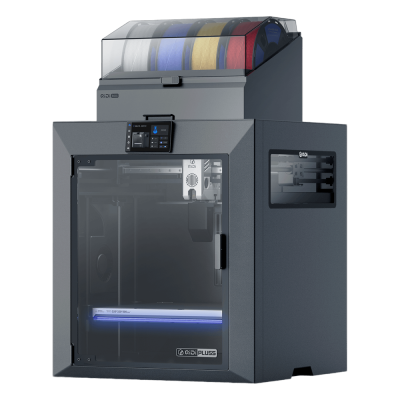
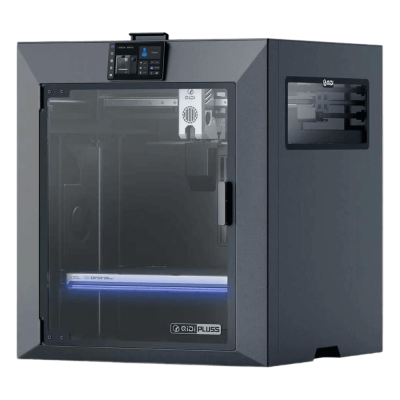
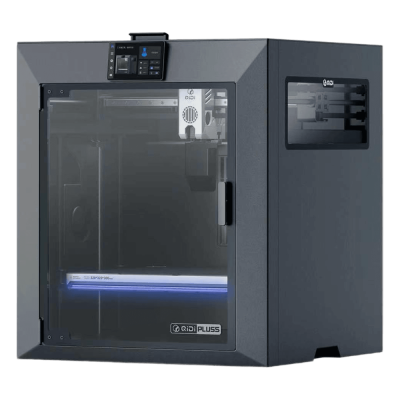
The Plus5 is Qidi's mid-size enclosed Klipper CoreXY: a 320 x 320 x 300 mm plate, a 370 °C hotend, a 65 °C actively heated chamber and HEPA plus carbon filtration, with the QIDI Box for multi-colour in the Combo. It is for makers and businesses that print engineering materials such as nylon, PC and carbon-filled filaments.
The SimplyPrint Client's QIDI integration supports the Plus5, including the QIDI Box: SimplyPrint shows each slot's filament and maps a print's filaments to the slots.
必要なもの: 同じネットワーク上で常時稼働し、SimplyPrintクライアントを実行するコンピューターまたはRaspberry Pi
The Plus5 connects through Klipper, but much of the printer's information is missing and the QIDI Box isn't supported. Use the SimplyPrint Client instead.
Editor's Choice. Praises the heated chamber, HEPA filtration, polished hardware and UI, and very little setup, with clean prints in engineering filaments such as PPS-CF. Tested without the QIDI Box, which the reviewer still considers unreliable, and dislikes the awkward rear filament loading.
“The QIDI Plus5 goes toe-to-toe with Bambu Lab’s H2 series for nearly half the price.”
ModBot · 2026年10月17日
Sees the 320 mm Plus5 as the middle ground between Qidi's Q2 and Max 4, with solid results from glass-filled TPU to ABS and detailed PLA. Issues: the CoreXY motion developed a squeak, filament profiles lack a plain ABS, and a filament sensor failed to trigger once, ruining a long print.
Aurora Tech · 2026年10月1日
Qidi-sponsored review (disclosed). Rates surface quality, accuracy, retraction and first layer as top-notch and the chamber and bed as very fast to heat, a clear step up from the Plus4. Cons: no dual extruder for support materials, a slow QIDI Box, minor firmware mismatches and awkward switching between very different filament temperatures.
QIDI Plus5 Comboを選択するケース
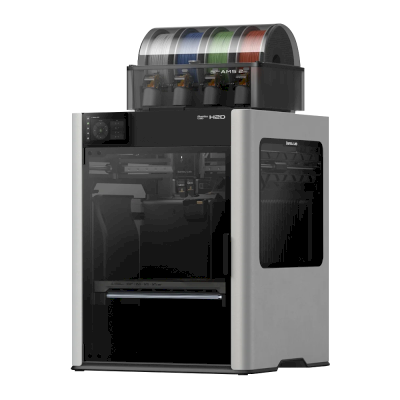
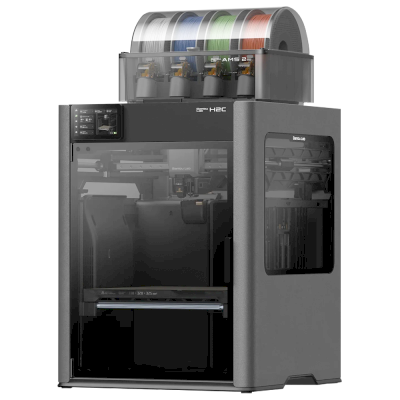
Choose the Plus5 for engineering materials in a polished, enclosed machine: Tom's Hardware made it an Editor's Choice and says it goes toe-to-toe with Bambu Lab's H2 series for nearly half the price. ModBot places it between the smaller Qidi Q2 and the larger Max4, so pick by plate size. Don't buy it for multi-colour PLA: Tom's Hardware still considers the QIDI Box unreliable and Aurora Tech found it slow, so a Bambu Lab P2S with the AMS or a tool changer such as the Snapmaker U1 suits colour work better. It has no second extruder for support materials (Aurora Tech), which the Bambu Lab H2D has.
メリット
A 65 °C heated chamber, a 370 °C hotend and a 120 °C bed for nylon, PC, carbon- and glass-filled filaments and PPS-CF (Qidi); Tom's Hardware got clean PPS-CF prints.
A three-stage filter with H12 HEPA and activated carbon (Qidi).
Very little setup and polished hardware and interface (Tom's Hardware); Aurora Tech rates surface quality, accuracy and first layers top-notch.
Load-cell auto levelling, a 1080p AI camera, and Wi-Fi, Ethernet and USB (Qidi).
Works with SimplyPrint through the SimplyPrint Client, which also shows and maps the QIDI Box's slots.
デメリット
The QIDI Box is the weak part: Tom's Hardware considers it unreliable and Aurora Tech found it slow.
Filament loads awkwardly from the rear (Tom's Hardware).
ModBot's unit developed a squeak in the motion system, and a filament sensor failed to trigger once, ruining a long print.
No dual extruder for support materials, and switching between very different filament temperatures is awkward (Aurora Tech).
おすすめの対象
学校適しています
Enclosed and filtered with very little setup, and SimplyPrint can hold student prints for approval; keep students to PLA and PETG, since its strengths are engineering materials.
ホビーユーザー適しています
Strong value for nylon, PC and composites; a weaker pick for colourful PLA with the QIDI Box.
企業最適
A heated, filtered chamber, Ethernet and engineering-grade results for nearly half the price of Bambu Lab's H2 series, per Tom's Hardware.
プリントファーム適しています
Enclosed and Ethernet-connected, and SimplyPrint controls it through the SimplyPrint Client, but ModBot's missed filament-sensor trigger is a warning for long unattended runs, and no plate-clearing kit is in our sources.
QIDI Tech is a Chinese 3D printer maker formed in 2014. It sells enclosed, Klipper-based CoreXY printers such as the compact Q2 and the larger Plus4 and Max4, and develops the open-source QIDI Studio slicer and the QIDI Link app.
QIDI is mostly open: its printers are standard Klipper machines you can run fully on the local network, with published source and plenty of spare parts. The phone app and the store-only privacy policy are the weak spots.
ファームウェアとカスタムファームウェア ●●●●●
QIDI printers run QIDI's editions of Klipper and Moonraker with Fluidd. QIDI publishes them and per-model firmware packages on GitHub under GPL (for example the Q2 in January 2026 and the Max4 in August 2026) and answers issues there.
[1][2][3]
ローカル制御と連携 ●●●●●
QIDI printers run Klipper and Moonraker with Fluidd on the printer, and QIDI Studio connects to them on the local network by IP without an account. QIDI publishes its Moonraker edition on GitHub, and other software can use Moonraker's documented API. Only the QIDI Link phone app needs an account and QIDI's cloud.
[4][5][11][12]
サードパーティー製フィラメント、スライサー、部品 ●●●●●
Third-party filament works; QIDI Studio is open source, and as Klipper and Moonraker printers they work with other Moonraker-compatible software. Hotends and nozzles are QIDI parts made per model.
[6][1][7]
修理と交換部品 ●●●●●
QIDI's store lists many individual parts, including motherboards, eMMC modules, fans, extruders, hotends and Wi-Fi cards, and its wiki has replacement guides such as the Plus4 hotend.
[7][8]
データとプライバシー ●●●●●
Local use needs no account. QIDI Link requires one and says which server it uses (Aliyun in China, AWS elsewhere). The published privacy policy covers the online store, not the printers or the app.
[5][9]
コミュニティとドキュメント ●●●●●
Firmware is released and issues are taken on GitHub, and QIDI keeps a wiki per model with manuals, maintenance and troubleshooting guides.
[1][4]
SimplyPrintからQIDIを実際に使用した経験に基づいています。評価には含まれません。
QIDI is one of the few printer makers we work with directly: they occasionally send us new printers, and put us in touch with their developers when we need them.
メリット
Runs fully on the local network through Fluidd, with no account needed.
Klipper and Moonraker sources and firmware updates are published on GitHub.
Many individual spare parts, down to motherboards and eMMC modules.
Open-source slicer and open filament choice.
デメリット
The QIDI Link app needs an account and QIDI's cloud.
The privacy policy covers only the online store, not the printers or app.
Hotends and nozzles are QIDI-specific parts.
実績
8月 2026: QIDI published the firmware repository for the Max4 on GitHub under GPL-3.0.
[2]
1月 2026: QIDI published the Q2's Klipper-based firmware on GitHub under GPL-3.0, with update packages and an issue tracker.
[1]
 中国
 SimplyPrintクライアント
 Klipper (Moonraker)


 PrusaSlicer
 OrcaSlicer
 BambuStudio
 ElegooSlicer
 CrealityPrint
 Cura
 Kiri:Moto



 米国に最適:QIDIの米国向けストア
 EU向けQIDI
 英国向けQIDI