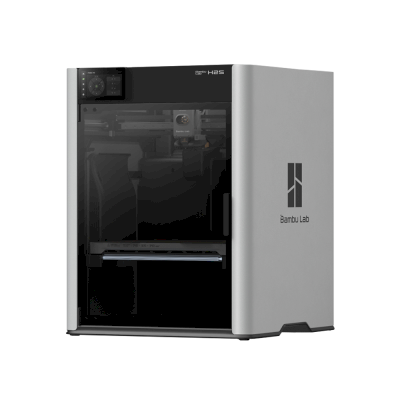
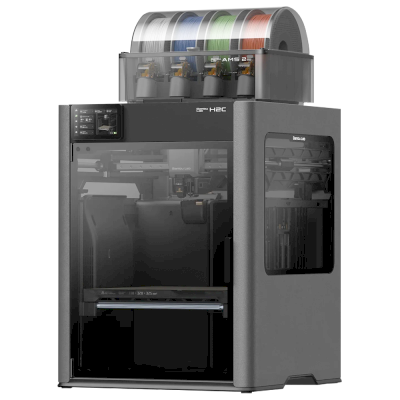
The H2S is Bambu Lab's large, fully enclosed single-nozzle printer: 340 x 320 x 340 mm, a 350 °C hotend and a 65 °C actively heated chamber. It is for makers and small businesses that want big, clean prints in everything from PLA to nylon and PC without paying for the H2D's second nozzle.
The 340 mm single-nozzle H2 machine with servo extruder, strong airflow and the AMS 2 Pro ($1,499 Combo). Sees skipping the second nozzle as a waste and says it will not dethrone the H2D, but it is a smart choice for a full-featured Bambu with a big plate. Editor's Choice.
“The H2S has a generous build volume that makers have been craving, but skipping the dual nozzle of the H2D seems like a waste.”
Reviewed the Combo. Exceptionally clean large prints in an enclosed chamber; about on par with the X1C at default speed, with a 20-30% cut in print times after tuning. Downsides: purge waste from the AMS, no dual nozzle, and not for first-time hobbyists. Recommended award.
“The test prints that came out of this machine were some of the cleanest I've seen”
Frankly Built · 2025年10月13日
Bambu sent the units and Polymaker sponsors the channel (disclosed). Calls the H2S his new favourite printer: big build volume, great results out of the box. Buy a separate laser if you want one, or look at the H2D.
CNC Kitchen · 2025年8月26日
Tested months early under embargo. Great for large single-material work: feeds soft TPU well and finished a six-day print with about 3,000 material changes without a failure. Gripes: heavy, a roughly 10 C bed temperature spread, closed ecosystem. Pick the H2D for real multi-material. VoxelPLA sponsored.
Made with Layers · 2025年8月26日
His take: more a bigger X1C than a baby H2D. Praises the design and near-flawless prints at a reasonable price, but finds it a poor fit for engineering filaments like PPS-CF, where the H2D is better. Suits single-material, PLA and PETG multicolour, or batch production. VoxelPLA sponsored part.
何时选择Bambu Lab H2S
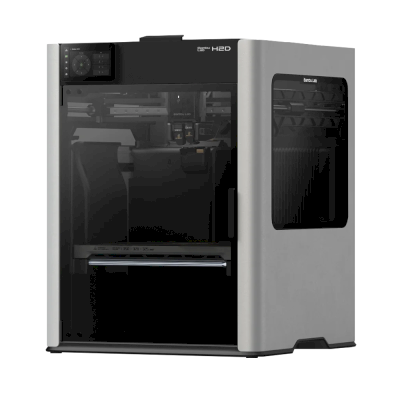
Choose the H2S when most of your work is single-material or simple multi-colour on a large plate, and you want an enclosed machine that handles ABS, ASA, nylon and PC. Multi-colour works with the AMS 2 Pro, AMS HT or first-generation AMS, but with one nozzle it purges more than the H2D, so if you print in several materials or want dedicated support material, the H2D is the better pick (Tom's Hardware, CNC Kitchen). If you want a lower price and can live with an open frame and basic filaments, the A2L is the cheaper large Bambu.
优点
Fully enclosed with an actively heated chamber (up to 65 °C) and a 350 °C hotend, so ABS, ASA, nylon and PC print well.
A 340 x 320 x 340 mm plate, and the servo extruder feeds soft TPU well (CNC Kitchen).
TechRadar called its test prints some of the cleanest it had seen, with print times cut 20-30% after tuning.
Reliable on very long jobs: CNC Kitchen finished a six-day print with about 3,000 material changes without a failure.
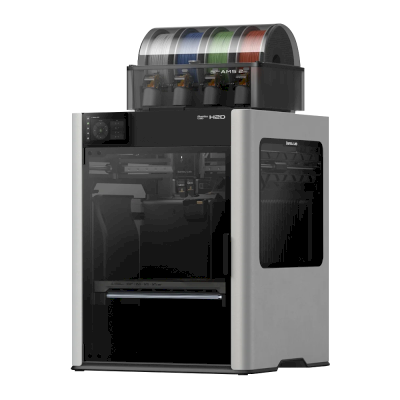
Great for multi-material with the AMS 2 Pro or AMS HT, up to 24 slots in total; the first-generation AMS also works, without drying (Bambu).
Works with SimplyPrint through the SimplyPrint Client, a verified connection.
缺点
One nozzle means more purge waste on multi-colour prints than the dual-nozzle H2D, and Tom's Hardware sees skipping the second nozzle as a waste.
Heavy, and CNC Kitchen measured a bed temperature spread of roughly 10 °C.
A poor fit for the hardest engineering filaments such as PPS-CF, where the H2D is better (Made with Layers).
Not aimed at first-time hobbyists (TechRadar), and the Combo launched at $1,499 (Tom's Hardware).
By default it runs through Bambu Lab's own software and cloud, which some organisations' compliance rules don't allow; with SimplyPrint it can run without them and use SimplyPrint's European cloud, in Bambu Lab's LAN-only mode (with Developer Mode on current firmware, which Bambu Lab doesn't support).
适合谁
学校适合
Enclosed, rated below 50 dB by Bambu, with flame sensors and an emergency stop, and SimplyPrint can hold student prints for approval; it is expensive for a classroom and not aimed at first-time users.
业余爱好者可用
Very capable, but more printer and more money than a first printer needs: start with an A1 Mini, or a P2S for multi-colour, and move up when you outgrow it.
企业非常适合
An enclosed, heated-chamber machine for engineering materials with strong reliability reports; the closed Bambu ecosystem is the one compliance question.
打印农场适合
Dependable on long jobs and the big plate suits batches, but the unit price is high and a single nozzle purges more than the H2D on colour work.
Bambu Lab is a Shenzhen company founded in 2020 by former DJI engineers. It makes FDM printers in four families (A, P, X and H), the AMS multi-material units, the Bambu Studio slicer, the Bambu Handy app and the MakerWorld model site, and designs them to be used together. Its printers are used by beginners, hobbyists, schools and print farms.
成立:
2020 ·
总部:
Shenzhen, China ·
所有权:
Privately held; founded by CEO Ye Tao and other former DJI staff, with venture investors (BGR, 2026) ·
网站:bambulab.com
Bambu Lab works like Apple: printer, slicer, app, cloud and multi-material system come from one company and are made to work together. Filament and slicer choice stay open, but the firmware is closed and signed, and since 2025 third-party control needs Bambu Connect or the unsupported Developer Mode.
固件和自定义固件 ●●●●●
The printer firmware is Bambu's own and closed; in 2022 Bambu said it would keep it in-house. Its security white paper describes secure boot that only runs verified firmware on X1, H2, P1 and A1 printers. Bambu publishes the GPL parts it uses (Linux kernel, U-Boot, BusyBox) but not the printer software. Rooting the X1 only became possible through a security flaw the X1Plus project used in 2024; Bambu then published a one-off rootable X1 firmware for owners who give up their warranty, and blocks rooting in later firmware.
[1][2][3][4][22]
本地控制与集成 ●●●●●
LAN Only mode prints and monitors from Bambu Studio or Bambu Connect without internet or an account; the Handy app, printing from outside the network and print history need Bambu's cloud. Since the 2025 authorization firmware, other software can only read status in normal mode. Full control needs Developer Mode, which cuts the cloud link and which Bambu says it cannot support because the protocols are not official. Bambu documents no local protocol; it offers a file hand-off to Bambu Connect and a Local Server SDK on application.
[23][24][6][7][5]
第三方耗材、切片软件和零件 ●●●●●
Third-party filament works, and Bambu publicly denied in 2025 that it would restrict it. OrcaSlicer and other slicers can be used, but since the 2025 firmware they send and control prints through Bambu Connect or Developer Mode. Hotends are Bambu's own designs, and Bambu says it cannot promise long-term support for accessories that control the printer unless it approved them first.
[7][6][4]
维修和备件 ●●●●●
Bambu's store sells individual spare parts down to motors, belts, encoders and boards, and its wiki has step-by-step replacement guides for each model (for example the P2S hotend and the H2D/H2C AP board). Many parts, hotends included, are Bambu-specific, so spares come from Bambu.
[8][9][10]
数据与隐私 ●●●●●
Cloud features need a Bambu account, while LAN Only mode keeps jobs on the local network. Bambu publishes a Trust Center and a 38-page security white paper, says it holds ISO/IEC 27001, ISO/IEC 27701 and TRUSTe certifications, and runs a paid bug bounty. In August 2023 a cloud outage made some printers start earlier jobs on their own; Bambu apologised.
[2][11][5][12]
社区和文档 ●●●●●
Very large user community, the MakerWorld model site, a detailed wiki and a blog where Bambu explains its policy changes. Bambu Studio is developed in public on GitHub with an open issue tracker. The printer protocol is not documented, and Developer Mode is unsupported.
[13][5][7]
优点
Printer, slicer, app and AMS come from one company and are designed to work together, which makes a first setup simple.
Step-by-step repair guides for each model and individual spare parts sold in Bambu's store.
LAN Only mode works without internet or an account.
Bambu Studio is open source, and third-party filament works.
Publishes security certifications and runs a public bug bounty.
缺点
Firmware is closed and signed; current models have no supported way to run custom firmware.
Since the 2025 firmware, third-party software and accessories need Bambu Connect or the unsupported Developer Mode to control the printer.
Remote printing, the Handy app and print history depend on Bambu's cloud.
Hotends and many parts are Bambu-specific, so spares come from Bambu.
In 2026 a US jury found the X1, P1 and A1 infringe Stratasys patents; Bambu is appealing.
实绩
九月 2026: A US federal jury in Texas found that Bambu Lab's X1, P1 and A1 printers infringe Stratasys patents on prime towers and bed levelling, and awarded Stratasys $27.6 million. No injunction was placed on the printers. Bambu told Tom's Hardware it disagrees with the verdict and intends to seek post-trial review and appeal. Stratasys had filed two suits in 2024; more patents are still to be decided.
[14]
五月 2026: Bambu Lab pressed the developer of 'OrcaSlicer-bambulab', a fork that restored direct cloud printing from OrcaSlicer, to remove it, according to Manufactur3D. On 7 May Bambu said the fork impersonated the official Bambu Studio client to its cloud, which its user agreement does not allow, and that modifying and sharing its AGPL code remains fine. The developer disputed the claims.
[15][16][17]
十月 2025: Bambu Lab opened a Trust Center with a security white paper and listed ISO/IEC 27001, ISO/IEC 27701 and TRUSTe privacy certifications. A year later it said its bug bounty had worked with over 100 researchers and that it had added a public security update log.
[2][11]
2025年1月20日: After criticism from users and print farms, Bambu Lab announced an optional Developer Mode for X1, P1, A1 and A1 mini that leaves MQTT, FTP and the live stream open for third-party software in LAN mode, without official support. It also said LAN mode via Bambu Connect needs neither internet nor an account, and that third-party filament would not be restricted.
[7]
2025年1月16日: Bambu Lab announced firmware with 'authorization control', first for the X1: starting prints, moving axes, changing temperatures and binding the printer now require Bambu-approved software, also in LAN mode. On updated printers, third-party slicers and accessories such as the Panda Touch could no longer control the printer except through Bambu Connect; reading status still worked. Bambu cited security and up to 30 million unauthorised cloud requests a day; older firmware stayed optional.
[6]
三月 2024: After the X1Plus jailbreak, Bambu Lab published a one-off rootable firmware for the X1 series for owners who give up their warranty support. It said it does not support X1Plus, and that firmware after it would block rooting again.
[4]
二月 2024: Bambu Lab extended its A1 heatbed-cable callback to a recall of all A1 printers and asked owners to stop using them. It reported electrical faults in under 0.1% of units and offered a full refund plus an $80 voucher, or a redesigned heatbed plus a $120 voucher and six extra months of warranty. The A1 mini was not affected.
[18][19]
一月 2024: Community developers rooted the X1 series through a security flaw in its firmware (up to version 1.07) and released the X1Plus custom firmware. Bambu Lab closed the flaw in later firmware.
[22]
八月 2023: During a Bambu cloud outage on 15 August 2023, some printers started print jobs without user action, because jobs stuck in the cloud were resent when service returned. Bambu apologised, took responsibility and said it would add checks before a print starts.
[12]
五月 2022: Before its first printers shipped, Bambu Lab said its firmware would stay closed and in-house to remain competitive, and promised to open-source everything if the company ever could not survive.
[1]
 中国
 SimplyPrint客户端





 PrusaSlicer
 CrealityPrint
 Cura
 Kiri:Moto



 最适合美国:Bambu Lab面向美国的商店
 面向澳大利亚的Bambu Lab
 面向加拿大的Bambu Lab
 面向欧盟的Bambu Lab
 面向英国的Bambu Lab