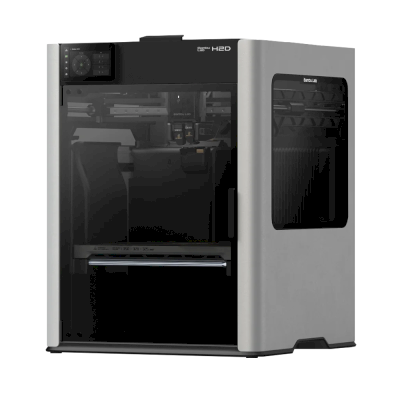
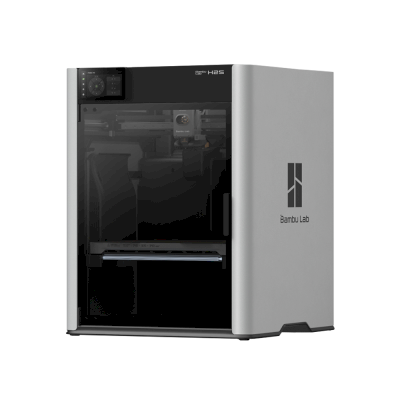
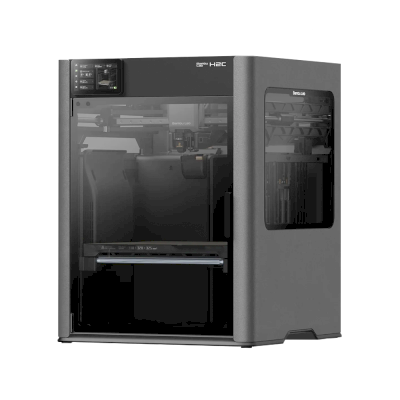
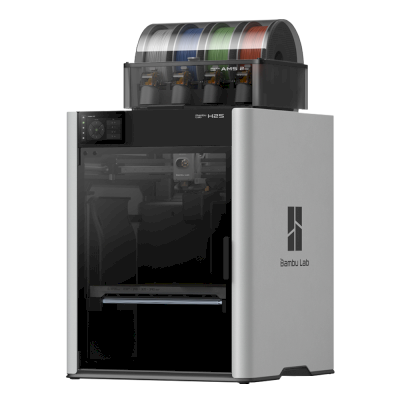
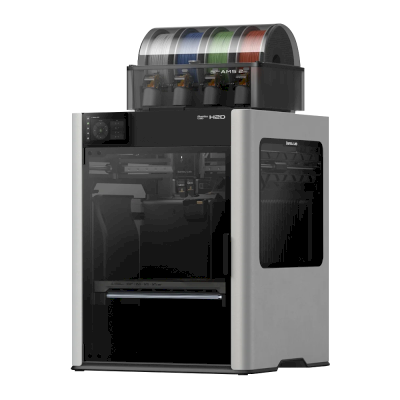
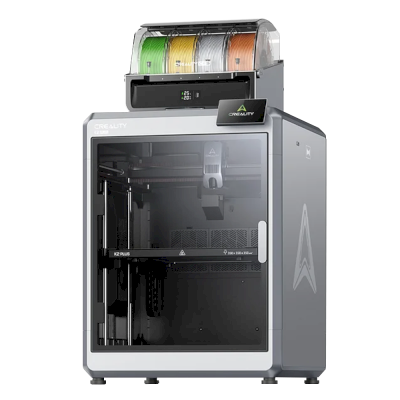
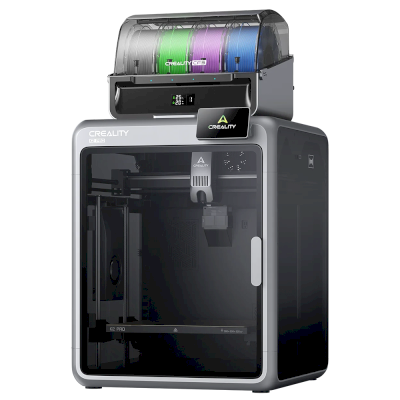
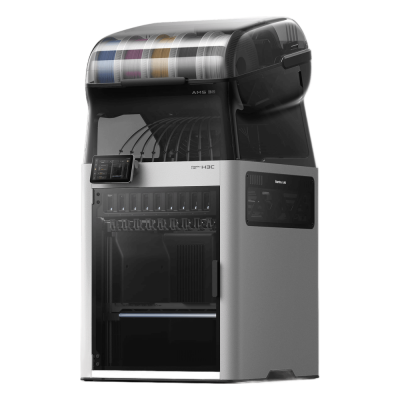
Bambu Lab's first true tool changer: nine PrintTools, each with its own hotend and filament path, swap in about six seconds, with the AMS 3H on top holding all nine spools. It is sold only as the AMS Combo, for people who print a lot of multicolor, mixed-material or soft TPU parts.
Funktioniert der 3D-Drucker Bambu Lab H3C mit SimplyPrint, OctoPrint, Mainsail und Fluidd?
Jede Verbindungsmöglichkeit, Voraussetzungen und Einrichtung.
SimplyPrint Client
Voraussichtlich kompatibel
Bambu Lab's newest H-series printer, expected to connect through the SimplyPrint Client the same way as the H2C, which SimplyPrint has tested. Not confirmed on the H3C yet.
Über SimplyPrint Client im reinen LAN-Modus verbunden, wird SimplyPrint voraussichtlich alles unterstützen, was der Bambu Lab H3C anderer Software ermöglicht: die Kamera und KI-Fehlererkennung, Drucken per Fernzugriff, Objekte überspringen, Temperatur- und Bewegungssteuerung, Filamentzuordnung für die Mehrmaterialeinheit und AutoPrint. Die einzigen Ausnahmen sind Funktionen, die Bambu Lab H3C anderer Software nicht erlaubt: Baby Stepping, Bettnivellierung und Z-Offset-Kalibrierung. Die folgende Tabelle vergleicht die beiden Verbindungsmöglichkeiten mit SimplyPrint.
Alle SimplyPrint-Funktionen für jede Verbindungsart mit SimplyPrint
Eingelegtes Filament aus der Multi-Material-Einheit synchronisieren
Ja3
Ja3
Automatisierung
AutoPrint
Pro
Ja
Kommt darauf an1
Datei vor Druckbeginn herunterladen
Ja
Vom Drucker nicht unterstützt2
Mit SimplyPrint über SimplyPrint Client (Nur-LAN-Modus, empfohlen) verbunden
Voraussichtlich kompatibel
Überwachung
Live-Status und FortschrittJa
WebcamJa
KI-FehlererkennungJa
Verbleibende ZeitJa
SchichtfortschrittJa
TemperaturenJa
Drucken
Druck startenJa
Pausieren, fortsetzen und abbrechenJa
Objekte überspringenJa
Druckstart-OptionenJa
Dateien
Geslicte 3MF-Dateien druckenJa
Druckersteuerung
Temperaturen ändernJa
Bewegen über die SteuerungJa
ReferenzfahrtJa
Extrudieren und zurückziehenJa
Druckgeschwindigkeit ändernJa
LüftergeschwindigkeitJa
Baby SteppingVom Drucker nicht unterstützt2
G-code sendenJa
Kalibrierung
Filament wechselnJa
BettnivellierungVom Drucker nicht unterstützt2
Z-Offset-KalibrierungVom Drucker nicht unterstützt2
Multimaterial
Filament Multi-Material-Slots zuordnenJa3
Eingelegtes Filament aus der Multi-Material-Einheit synchronisierenJa3
Automatisierung
AutoPrint ProJa
Datei vor Druckbeginn herunterladenJa
Mit SimplyPrint über SimplyPrint Client (Cloud-Modus) verbunden
Voraussichtlich kompatibel
Überwachung
Live-Status und FortschrittJa
WebcamJa
KI-FehlererkennungJa
Verbleibende ZeitJa
SchichtfortschrittJa
TemperaturenJa
Drucken
Druck startenKommt darauf an1
Pausieren, fortsetzen und abbrechenKommt darauf an1
Objekte überspringenKommt darauf an1
Druckstart-OptionenKommt darauf an1
Dateien
Geslicte 3MF-Dateien druckenJa
Druckersteuerung
Temperaturen ändernJa
Bewegen über die SteuerungKommt darauf an1
ReferenzfahrtKommt darauf an1
Extrudieren und zurückziehenKommt darauf an1
Druckgeschwindigkeit ändernKommt darauf an1
LüftergeschwindigkeitKommt darauf an1
Baby SteppingVom Drucker nicht unterstützt2
G-code sendenKommt darauf an1
Kalibrierung
Filament wechselnKommt darauf an1
BettnivellierungVom Drucker nicht unterstützt2
Z-Offset-KalibrierungVom Drucker nicht unterstützt2
Multimaterial
Filament Multi-Material-Slots zuordnenJa3
Eingelegtes Filament aus der Multi-Material-Einheit synchronisierenJa3
Automatisierung
AutoPrint ProKommt darauf an1
Datei vor Druckbeginn herunterladenVom Drucker nicht unterstützt2
Funktioniert
Kommt darauf an
Nicht unterstützt
Vom Drucker nicht unterstützt
Bambu-Lab-Firmware ab 2025 erlaubt im Cloud-Modus nur die Überwachung: Nutze den Nur-LAN-Modus, um Drucke zu starten und den Drucker zu steuern. Ältere Firmware erlaubt weiterhin beides.
Der Drucker bietet dies anderer Software nicht an.
Benötigt eine Mehrmaterialeinheit
Welchen Slicer für Bambu Lab H3C nutzen
Bambu Lab-Drucker verwenden BambuStudio, den eigenen Slicer von Bambu Lab. Für Bambu Lab H3C gibt es in unserer Cloud noch kein fertiges Profil.
Wir führen nur Slicer auf, die du in der SimplyPrint-Cloud nutzen kannst. Daher kann es weitere für den Bambu Lab H3C geben.
Cloud-basierter Slicer für Bambu Lab H3C: BambuStudio online nutzen
Nutze BambuStudio und andere Slicer direkt in deinem Browser mit dem Online-Cloud-Slicer von SimplyPrint. Keine Installation nötig. Slice deine Bambu Lab H3C-Modelle von jedem Gerät überall auf der Welt!
Automatische Profilupdates: Profile werden täglich in den GitHub-Repositories der Slicer sowie in unserer eigenen Open-Source-Community-Datenbank für Slicer-Profile geprüft und abgerufen. So hast du immer Zugriff auf die neuesten Profile.
Hinweis: Andere Slicer wie Simplify3D, ideaMaker, SuperSlicer und KISSlicer sind nicht in unserer Cloud verfügbar, daher verfolgen wir ihre Profile nicht. Sie funktionieren möglicherweise dennoch gut mit deinem Bambu Lab H3C: Suche in der Dokumentation oder in Foren des Slicers nach einem Profil. Du kannst auch Profile zu unserer Open-Source-Datenbank für Slicer-Profile auf GitHub beitragen.
Die App für Bambu Lab H3C
SimplyPrint dient als App für Bambu Lab H3C: auf deinem Smartphone und in jedem Browser, mit einem Slicer in der Cloud.
Für den Bambu Lab H3C gibt es in SimplyPrint noch keinen Plattenwechsler oder automatischen Auswurf-Kit, aber AutoPrint kann ihn trotzdem weiterdrucken lassen: Sobald die Platte frei ist, startet es den nächsten Auftrag aus deiner Warteschlange.
Geschlossene Drucker schieben ihre Drucke heraus
Das Druckbett des Bambu Lab H3C bewegt sich in seinem Gehäuse nur auf und ab. Statt Druckplatten zu wechseln, ermöglichen Kits wie diese dem Druckkopf, den abgekühlten Druck von der Platte und durch die Vordertür herauszuschieben, die sie nach Druckende für dich öffnen.
Drucke mit dem Druckkopf herunterstoßenBei einem CoreXY-Drucker kann eine G-code-Routine den abgekühlten Druck vor dem nächsten Auftrag vorne von der Druckplatte schieben.
Ein Roboterarm oder etwas mit einer APIMelde SimplyPrint per API oder Webhook, dass die Druckplatte frei ist, über einen Roboterarm oder dein eigenes System.
Ja
Verfügbare Optionen: Use AMS, Bed Leveling, Flow Calibration, Timelapse
Der Drucker
Druckerhersteller / -marke
Bambu Lab
Name des Druckermodells
H3C
Hergestellt von einem Unternehmen aus
China
Veröffentlichung
3. November 2026
Wird noch hergestellt
Ja
Haftungsausschluss:
Wir bemühen uns, diese Informationen so aktuell und genau wie möglich zu halten, können aber keine Vollständigkeit oder Zuverlässigkeit garantieren. Unsere Daten basieren auf Nutzereinreichungen und Herstellerangaben.
Welches Filament kann Bambu Lab H3C drucken?
Filamentkompatibilität für den Bambu Lab H3C: die von Bambu Lab dafür angegebenen Materialien.
Filament
Eignung
Notizen
PLA
Großartig
Auf der Materialliste des Herstellers für diesen Drucker.
PETG
Großartig
Auf der Materialliste des Herstellers für diesen Drucker.
TPU und flexible Materialien
Großartig
Auf der Materialliste des Herstellers für diesen Drucker.
ABS & ASA
Großartig
Auf der Materialliste des Herstellers für diesen Drucker.
Nylon (PA)
Großartig
Auf der Materialliste des Herstellers für diesen Drucker.
Polycarbonate (PC)
Großartig
Auf der Materialliste des Herstellers für diesen Drucker.
Kohlefaser- und glasfasergefüllt
Großartig
Auf der Materialliste des Herstellers für diesen Drucker.
Hochtemperatur (PEI, PEEK, PEKK)
Großartig
Auf der Materialliste des Herstellers für diesen Drucker.
Tipp: Dies ist eine allgemeine Anleitung anhand der Druckerspezifikationen. Prüfe immer die empfohlenen Einstellungen deines Filaments. Mit SimplyPrint kannst du für jede Spule ein Profil speichern und genau verfolgen, welches Filament du auf Lager hast.
Bestes Filament für den Bambu Lab H3C
Filamente, die Bambu Lab H3C gut druckt, zuerst von Bambu Lab, dann die bekanntesten.
Tested on firmware that was updated several times during the review: it printed everything from soft TPU to PPS well, swapped nozzles quickly and mixed nozzle sizes in one print. Downsides are the price, a height of over four feet, a clicking stepper motor and one tool's tube catching and dismounting it in long prints. Editor's Choice.
“The Bambu Lab H3C is an excellent nine-tool 3D printer that printed everything we could throw at it.”
After a month of use, the standout is printing with different nozzle sizes and materials in one part, such as PLA walls with TPU infill. Against it: a complex, large and heavy machine, software that takes some working out, and a first calibration of about an hour. Editor's Choice.
“The big innovations here are the ability to print with different nozzle sizes, and while this still feels like a technology in development, the potential is obvious.”
CNC Kitchen · 3. November 2026
Sponsored by VoxelPLA (disclosed). After almost 400 hours: tool changes of 6-7 seconds against about 40 on the H2C, very good quality, and the best option for soft TPU through the 2.85 mm tool. Drawbacks: the AMS 3H sits high, about 50 mg purged per change, and real-world speed only about 10% above the H2C.
Wann du dich für den Bambu Lab H3C entscheiden solltest
Choose it when you print multicolor or mixed materials often: tool changes take about 6-7 seconds where the H2C needs around 40, and its 2.85 mm tool prints TPU softer than most printers can. If two materials are enough, the H2D costs almost $1,000 less; the H2C handles up to seven filaments for less; and the Snapmaker U1, with four tools, is far cheaper. It is very tall with the AMS 3H on top, so check your shelf and ceiling first.
Vorteile
Nine tools swap in about six seconds, so multicolor prints are much faster than on a single-nozzle printer.
A dedicated 2.85 mm tool prints very soft TPU.
Different nozzle sizes and materials can be mixed in one print.
Fully enclosed with 65 °C active chamber heating and HEPA and carbon filtration, so ABS, ASA, PC and nylon print well.
Expected to work with SimplyPrint through the SimplyPrint Client, like the H2C.
Nachteile
Expensive at $2,499, and sold only as the AMS Combo.
Very tall with the AMS 3H on top, so loading spools can take a step or the Bambu Station.
The AMS 3H dries only two spools at a time.
Wi-Fi only: there is no Ethernet port.
It runs through Bambu Lab's own software and cloud, which some organisations' compliance rules don't allow; connected through SimplyPrint it can be cut off from that and use SimplyPrint's European cloud.
Für wen geeignet
SchulenKann funktionieren
Enclosed and filtered, but expensive, very tall and more complex than a classroom usually needs.
HobbyanwenderPasst gut
The fastest way to print nine colors or soft TPU at home, if the price and height fit.
UnternehmenPasst sehr gut
Engineering materials, mixed nozzle sizes and quick tool changes suit prototypes and multi-material parts.
DruckfarmenKann funktionieren
Costly per machine and Wi-Fi only; for identical single-color jobs, cheaper printers do the same work.
Basierend auf Herstellerangaben und unabhängigen Bewertungen.
Mehr vom Hersteller
Den Bambu Lab H3C mit ähnlichen Druckern vergleichen
Drucker desselben Herstellers in ähnlicher Größe, die dieselben technischen Materialien drucken oder wie dieser Drucker mehrere Materialien verarbeiten und heute erhältlich sind. Vergleiche bis zu vier direkt anhand ihrer Daten und Verbindungsarten.
Wer den Bambu Lab H3C herstellt und wie offen Bambu Lab ist: ob die Drucker ohne eigene Cloud funktionieren, beliebiges Filament und jeden Slicer akzeptieren und repariert werden können. Jeder Bereich wird anhand öffentlicher Quellen bewertet.
Offenheit: Weitgehend geschlossen (2.3 von 5)
Weitgehend geschlossen
Abgeschlossenes ÖkosystemÖffnen
Bambu Lab is a Shenzhen company founded in 2020 by former DJI engineers. It makes FDM printers in four families (A, P, X and H), the AMS multi-material units, the Bambu Studio slicer, the Bambu Handy app and the MakerWorld model site, and designs them to be used together. Its printers are used by beginners, hobbyists, schools and print farms.
Gegründet:
2020 ·
Hauptsitz:
Shenzhen, China ·
Eigentümerschaft:
Privately held; founded by CEO Ye Tao and other former DJI staff, with venture investors (BGR, 2026) ·
Website:bambulab.com
Bambu Lab works like Apple: printer, slicer, app, cloud and multi-material system come from one company and are made to work together. Filament and slicer choice stay open, but the firmware is closed and signed, and since 2025 third-party control needs Bambu Connect or the unsupported Developer Mode.
Firmware und angepasste Firmware ●●●●●
The printer firmware is Bambu's own and closed; in 2022 Bambu said it would keep it in-house. Its security white paper describes secure boot that only runs verified firmware on X1, H2, P1 and A1 printers. Bambu publishes the GPL parts it uses (Linux kernel, U-Boot, BusyBox) but not the printer software. Rooting the X1 only became possible through a security flaw the X1Plus project used in 2024; Bambu then published a one-off rootable X1 firmware for owners who give up their warranty, and blocks rooting in later firmware.
[1][2][3][4][22]
Lokale Steuerung und Integrationen ●●●●●
LAN Only mode prints and monitors from Bambu Studio or Bambu Connect without internet or an account; the Handy app, printing from outside the network and print history need Bambu's cloud. Since the 2025 authorization firmware, other software can only read status in normal mode. Full control needs Developer Mode, which cuts the cloud link and which Bambu says it cannot support because the protocols are not official. Bambu documents no local protocol; it offers a file hand-off to Bambu Connect and a Local Server SDK on application.
[23][24][6][7][5]
Filament, Slicer und Teile von Drittanbietern ●●●●●
Third-party filament works, and Bambu publicly denied in 2025 that it would restrict it. OrcaSlicer and other slicers can be used, but since the 2025 firmware they send and control prints through Bambu Connect or Developer Mode. Hotends are Bambu's own designs, and Bambu says it cannot promise long-term support for accessories that control the printer unless it approved them first.
[7][6][4]
Reparaturen und Ersatzteile ●●●●●
Bambu's store sells individual spare parts down to motors, belts, encoders and boards, and its wiki has step-by-step replacement guides for each model (for example the P2S hotend and the H2D/H2C AP board). Many parts, hotends included, are Bambu-specific, so spares come from Bambu.
[8][9][10]
Daten und Datenschutz ●●●●●
Cloud features need a Bambu account, while LAN Only mode keeps jobs on the local network. Bambu publishes a Trust Center and a 38-page security white paper, says it holds ISO/IEC 27001, ISO/IEC 27701 and TRUSTe certifications, and runs a paid bug bounty. In August 2023 a cloud outage made some printers start earlier jobs on their own; Bambu apologised.
[2][11][5][12]
Community und Dokumentation ●●●●●
Very large user community, the MakerWorld model site, a detailed wiki and a blog where Bambu explains its policy changes. Bambu Studio is developed in public on GitHub with an open issue tracker. The printer protocol is not documented, and Developer Mode is unsupported.
[13][5][7]
Vorteile
Printer, slicer, app and AMS come from one company and are designed to work together, which makes a first setup simple.
Step-by-step repair guides for each model and individual spare parts sold in Bambu's store.
LAN Only mode works without internet or an account.
Bambu Studio is open source, and third-party filament works.
Publishes security certifications and runs a public bug bounty.
Nachteile
Firmware is closed and signed; current models have no supported way to run custom firmware.
Since the 2025 firmware, third-party software and accessories need Bambu Connect or the unsupported Developer Mode to control the printer.
Remote printing, the Handy app and print history depend on Bambu's cloud.
Hotends and many parts are Bambu-specific, so spares come from Bambu.
In 2026 a US jury found the X1, P1 and A1 infringe Stratasys patents; Bambu is appealing.
Erfolgsbilanz
September 2026: A US federal jury in Texas found that Bambu Lab's X1, P1 and A1 printers infringe Stratasys patents on prime towers and bed levelling, and awarded Stratasys $27.6 million. No injunction was placed on the printers. Bambu told Tom's Hardware it disagrees with the verdict and intends to seek post-trial review and appeal. Stratasys had filed two suits in 2024; more patents are still to be decided.
[14]
Mai 2026: Bambu Lab pressed the developer of 'OrcaSlicer-bambulab', a fork that restored direct cloud printing from OrcaSlicer, to remove it, according to Manufactur3D. On 7 May Bambu said the fork impersonated the official Bambu Studio client to its cloud, which its user agreement does not allow, and that modifying and sharing its AGPL code remains fine. The developer disputed the claims.
[15][16][17]
Oktober 2025: Bambu Lab opened a Trust Center with a security white paper and listed ISO/IEC 27001, ISO/IEC 27701 and TRUSTe privacy certifications. A year later it said its bug bounty had worked with over 100 researchers and that it had added a public security update log.
[2][11]
20. Januar 2025: After criticism from users and print farms, Bambu Lab announced an optional Developer Mode for X1, P1, A1 and A1 mini that leaves MQTT, FTP and the live stream open for third-party software in LAN mode, without official support. It also said LAN mode via Bambu Connect needs neither internet nor an account, and that third-party filament would not be restricted.
[7]
16. Januar 2025: Bambu Lab announced firmware with 'authorization control', first for the X1: starting prints, moving axes, changing temperatures and binding the printer now require Bambu-approved software, also in LAN mode. On updated printers, third-party slicers and accessories such as the Panda Touch could no longer control the printer except through Bambu Connect; reading status still worked. Bambu cited security and up to 30 million unauthorised cloud requests a day; older firmware stayed optional.
[6]
März 2024: After the X1Plus jailbreak, Bambu Lab published a one-off rootable firmware for the X1 series for owners who give up their warranty support. It said it does not support X1Plus, and that firmware after it would block rooting again.
[4]
Februar 2024: Bambu Lab extended its A1 heatbed-cable callback to a recall of all A1 printers and asked owners to stop using them. It reported electrical faults in under 0.1% of units and offered a full refund plus an $80 voucher, or a redesigned heatbed plus a $120 voucher and six extra months of warranty. The A1 mini was not affected.
[18][19]
Januar 2024: Community developers rooted the X1 series through a security flaw in its firmware (up to version 1.07) and released the X1Plus custom firmware. Bambu Lab closed the flaw in later firmware.
[22]
August 2023: During a Bambu cloud outage on 15 August 2023, some printers started print jobs without user action, because jobs stuck in the cloud were resent when service returned. Bambu apologised, took responsibility and said it would add checks before a print starts.
[12]
Mai 2022: Before its first printers shipped, Bambu Lab said its firmware would stay closed and in-house to remain competitive, and promised to open-source everything if the company ever could not survive.
[1]
Recherchiert anhand von 24 Quellen, zuletzt geprüft am 20. Oktober 2026. Quellen anzeigen
Wie Bambu Lab im Vergleich zu allen anderen Marken abschneidet und welche Drucker wir kaufen würden: die besten 3D-Drucker 2026.
Häufig gestellte Fragen
Ist Bambu Lab H3C mit SimplyPrint kompatibel?
Sehr wahrscheinlich. Wir erwarten, dass sich der Bambu Lab H3C über SimplyPrint Client mit SimplyPrint verbindet, aber bisher hat es niemand bestätigt. Wenn du einen hast, zeigt die Einrichtungsanleitung in wenigen Minuten, ob es funktioniert, und deine Antwort bestätigt es für alle.
Wie verbinde ich den Bambu Lab H3C mit SimplyPrint?
Folge unserer Schritt-für-Schritt-Anleitung für den Bambu Lab H3C. Sie zeigt dir, wie du ihn über SimplyPrint Client verbindest, was du jeweils brauchst und welche Methode du wählen solltest.
Welchen Slicer sollte ich für den Bambu Lab H3C verwenden?
Nutze BambuStudio, den eigenen Slicer von Bambu Lab für dessen Drucker. Du kannst ihn im Online-Slicer von SimplyPrint nutzen, dort gibt es aber noch kein fertiges Profil für den Bambu Lab H3C.
Kann ich OrcaSlicer mit dem Bambu Lab H3C nutzen?
Ja, aber OrcaSlicer hat unseres Wissens kein integriertes Profil für den Bambu Lab H3C: Starte mit dem Profil eines ähnlichen Druckers und passe Druckbettgröße, Höhe und Düse an.
Welches Filament kann Bambu Lab H3C drucken?
Bambu Lab führt PLA, PETG, TPU und flexible Materialien, ABS & ASA, Nylon (PA), Polycarbonate (PC), Kohlefaser- und glasfasergefüllt und Hochtemperatur (PEI, PEEK, PEKK) für H3C auf.
Funktioniert der Bambu Lab H3C mit OctoPrint oder Klipper?
Soweit wir wissen, nicht, aber du brauchst beides nicht: SimplyPrint verbindet sich über SimplyPrint Client mit dem Bambu Lab H3C.
Wie groß sind Druckbett und Bauraum von Bambu Lab H3C?
Der Bambu Lab H3C hat ein Druckbett von 330 x 320 mm und druckt bis zu 325 mm hoch, mit einem Bauvolumen von etwa 330 x 320 x 325 mm. Die vollständige Tabelle oben enthält Bettart, Temperaturen und mehr.
Wann erschien Bambu Lab H3C?
Bambu Lab brachte H3C am 3. November 2026 auf den Markt.
Kann der Bambu Lab H3C Drucke automatisch auswerfen?
Dafür gibt es noch kein unterstütztes Kit, aber AutoPrint von SimplyPrint kann Drucke mit dem Druckkopf herunterschieben oder deinen eigenen Auswurf-G-Code ausführen und danach den nächsten Auftrag aus deiner Warteschlange starten.
Affiliate-Hinweis: Einige Links auf dieser Seite sind Affiliate-Links. Bei einem Kauf erhalten wir möglicherweise eine Provision, ohne Mehrkosten für dich. Als Amazon-Partner verdienen wir an qualifizierten Käufen.
 China
 SimplyPrint Client



 PrusaSlicer
 OrcaSlicer
 ElegooSlicer
 CrealityPrint
 Cura
 Kiri:Moto